Cyber attacks on functions of society are no longer a question of if, but of when. Linux Service, part of Datorkirurgen AB, presents here our list of fifty functions of society, companies and authorities that we believe attackers will strike. In addition, we explain how the warfare of foreign powers has changed form, why organisations need our own cybersecurity agents and what our conviction and our guarantee mean.
Warfare has changed form after NATO membership
The warfare, surveillance, sabotage and cold wars of foreign powers no longer take place only on the battlefield with tanks, armoured vehicles, weapons, drones and fighter aircraft. Warfare has changed its form, shape and face, particularly with regard to Sweden’s membership of NATO. The Swedish Military Intelligence and Security Service states that Russia has operational military planning directed at Sweden and NATO, and the Swedish Security Service has seen attempts at destructive cyber attacks from Russia.
Therefore, foreign powers constantly run tests, probe, analyse and carry out tolerance attacks against society’s critical functions and services. A tolerance attack tests the systems’ weaknesses and missed security, and it also shows where the line goes for when society reacts. The Swedish Security Service has also stated that Russia has tasked proxies with mapping and documenting protected sites in Sweden.
The tests run constantly and look for weaknesses and ways in across transport, railway tracks and every barrier where trains pass, air traffic, hospitals, traffic light networks, petrol stations and charging stations, as well as bridges and their bridge-opening control systems. Charging stations are a clear example, because manufacturers and installers often have constant remote access to them. Datorkirurgen AB has described this in its article on the cybersecurity of EV chargers.
Preparations for doomsday are constantly under way
Preparations are constantly under way for doomsday, that is, when the comprehensive war breaks out. Among others, several Russian military analysts and advisers on the Kremlin’s warfare are convinced that a large-scale war between Russia and NATO is both inevitable and close at hand. Analysts in the Kremlin-aligned Valdai Club moreover openly describe a permanent hybrid war on the West as a necessity.
Our analysis is moreover confirmed by Ben Hodges, former commander of US Army Europe. On Swedish public broadcaster SVT on 22 November 2026, he warns that Russia in a war will use missiles, drones and glide bombs against the infrastructure of NATO countries. Ports in Scania and on the west coast, for example Gothenburg, become targets, because NATO’s reinforcement of the Baltic states passes through them. He believes that Europe is not ready, and he therefore calls for exercises that include cyber attacks and electronic warfare.
The physical and the digital attacks thus target the same functions of society, and the digital attacks come first. Datorkirurgen AB’s assessment is that attacks such as the freezer attack are tests and preparations for considerably larger and coordinated attacks. The aim is to strike several authorities, businesses, industries and functions of society at the same time, and thereby sabotage and paralyse cities and the whole country. You can find more about the attackers in our article on cyber attacks from foreign powers.
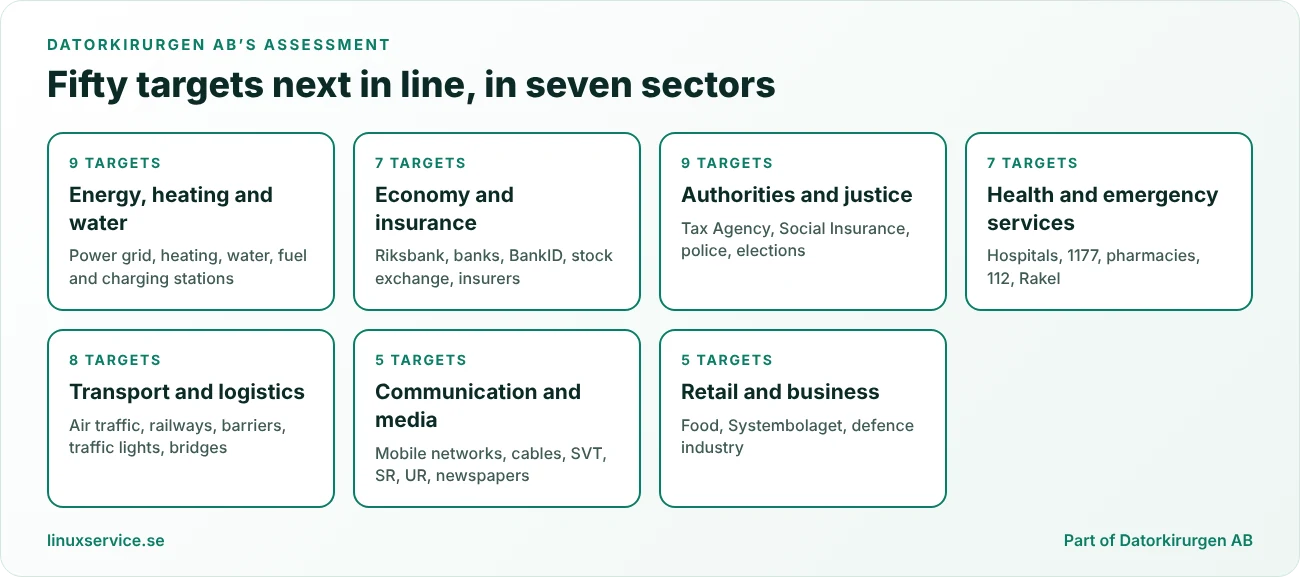
Our list: 50 targets next in line
The list builds on our experience, on attacks that have already happened in Sweden and Europe and on where an attacker gets the greatest effect with the least effort. The order is not a ranking, because a coordinated attacker strikes several targets at once.
Cyber attacks on functions of society in energy, heating and water
- Power grids and the national grid. Without electricity everything else stops, and attackers have moreover already tried to knock out parts of the Polish energy system.
- Nuclear power plants. The control and monitoring systems are admittedly isolated, but the suppliers’ service routes and the office networks around them are not always.
- Hydropower and dams. Remotely controlled gates and regulation therefore affect both power production and safety downstream.
- Wind farms. In addition, suppliers often control and monitor the farms remotely, sometimes from other countries.
- District heating. A stoppage in the middle of winter hits whole districts, hospitals and care homes within hours.
- Drinking water and sewage. The control systems of waterworks are often connected for remote monitoring and therefore reachable.
- Petrol stations and fuel depots. Digital systems control pumps and payment terminals, and without fuel, transport, backup power and emergency services thus stop within a few days.
- Charging stations for electric cars. Manufacturers and installers often have constant remote access to the chargers, and thousands of chargers controlled at once moreover affect the power grid.
- Backup power. Digital systems control the generators of hospitals and data centres, and an attack can knock them out exactly when the grid fails.
Economy, payments and insurance
- The Riksbank and the RIX payment system. All larger payments between the banks namely pass through the same central system.
- The banks. An attack on a major bank consequently affects salaries, loans and payments for millions of customers.
- BankID and electronic identification. Without electronic identification, contact with banks, authorities and healthcare moreover stops at the same time.
- Card payments, Swish and Bankgirot. Trade stops when payments stop working, because cash is not enough.
- The stock exchange and securities trading. An outage or manipulated prices thereby damage trust in the entire Swedish market.
- Insurance companies. They hold large amounts of sensitive information about health, property and damage, and an attack stops compensation after a crisis.
- The Pensions Agency and pension companies. Payments reach millions of pensioners every month, and the funds furthermore manage very large sums.
Cyber attacks on functions of society at authorities and in the justice system
- The Swedish Tax Agency. The population register and personal identity numbers are the basis of almost every identity and every payment in Sweden, and an attack therefore has consequences throughout society.
- The Social Insurance Agency. Child benefit, sickness benefit and parental benefit moreover reach millions of households every month.
- The police. Investigations, registers and command systems are also attractive to both foreign powers and criminal networks.
- The courts and the Prosecution Authority. An attack can delay trials or reveal protected information about witnesses and injured parties.
- The Migration Agency. The agency additionally holds information about people whom foreign powers map and persecute.
- The Election Authority and the election system. The Swedish Security Service warned of influence operations ahead of the 2026 election, and trust in the election is an obvious target.
- The Land Survey and the property register. The ownership of every property in the country namely rests on a single register.
- The Transport Agency and the vehicle register. Registers, licences and permits consequently govern road traffic, aviation and shipping.
- The municipalities. Schools, care, water and social services moreover come together in one organisation, often with limited IT resources.
Health and emergency services
- Hospitals and regions. Medical records, X-ray and medical technology depend on working networks, and every hour of downtime affects patients.
- Medical record systems and 1177. A small number of systems namely hold health information about almost the entire population.
- Health centres and dental care. Smaller clinics, on the other hand, often have weaker protection but records just as sensitive as the hospitals’.
- Pharmacies and the supply of medicines. Prescriptions, stock and deliveries namely depend on a few central systems.
- Elderly care and personal alarms. Digital alarms and medication robots moreover sit with the most vulnerable people.
- SOS Alarm and 112. An attack on the emergency call centres delays help exactly when people are in greatest need.
- Rescue services, ambulances and the Rakel radio system. The command and communications of the emergency services are therefore a clear target in a crisis.
Transport and logistics
- Air traffic control. A coordinated attack at night can therefore paralyse air traffic across the whole country.
- Airports and check-in. The attack on Collins Aerospace stopped check-in at several European airports at the same time.
- Railways and signalling. Digital systems control signals, points and timetables, and a stoppage paralyses both freight and passenger traffic.
- Level crossings and barriers. Barriers and warning lights where trains cross roads operate automatically, and a fault there has direct consequences for life and health.
- Public transport. A stoppage at rush hour moreover paralyses a whole region and creates anxiety within minutes.
- Ports and shipping. In addition, imports of fuel and goods pass through a small number of ports with their own control systems, and the ports of Gothenburg and Scania are crucial for NATO’s reinforcements.
- Traffic lights and signal networks. Central, connected systems namely control the traffic signals in the cities, and an attack can create chaos at rush hour.
- Bridges and bridge-opening systems. Opening bridges and their control systems govern both road traffic and shipping, and a manipulated opening system moreover stops both at once.
Communication and media
- Mobile networks and telecoms. Mobile networks carry all other functions of society, and an outage knocks out alarms, payments and information at once.
- The internet, DNS and fibre. Without name lookups and fibre, nobody thus reaches their cloud services, however well protected the services are.
- Undersea cables and data centres. The cable breaks in the Baltic Sea moreover show that the connections to the outside world are already a target.
- Public radio and television: SVT, Sveriges Radio and UR. Public service broadcasts crisis information and Important Public Announcements, and a hijacked broadcast can spread panic or fall silent in the crisis.
- Daily newspapers and news sites. A hijacked news site can publish false news in the name of an established sender and undermine trust in all information.
Retail and business
- Food retail chains and warehouses. The freezer attack showed how quickly food worth millions is lost, and in 2021 Coop closed around 800 shops after an attack on a supplier.
- Systembolaget. A state retail monopoly with central logistics, online sales and shops all over the country, where an attack becomes a symbolic and visible disruption for the whole of Sweden.
- The defence industry. The Swedish Security Service has warned that the risk of Russian sabotage has increased and that the defence industry is particularly exposed.
- IT suppliers and operations companies. A single attack on a supplier therefore reaches hundreds of customers, authorities and municipalities at the same time.
- Building automation, lifts and access control. Ventilation, heating, locks and lifts in offices, hospitals and homes moreover often depend on the same connected system.
Systembolaget, public service and the daily newspapers
We particularly highlight Systembolaget, SVT, Sveriges Radio, UR and the daily newspapers, because the debate about critical infrastructure rarely mentions them. Even so, they are obvious targets. Systembolaget is a state monopoly that the whole country knows, and a stoppage therefore becomes a visible symbol that the state has lost control.
Furthermore, public service and the daily newspapers carry the trust in all information. If an attacker takes over a broadcast or a news site, the attacker can spread false information under an established sender, or silence the channel exactly when the public is waiting for crisis information. The same applies to the Swedish Tax Agency and the insurance companies, where an attack shakes trust that society can pay out and protect.
Why cyber attacks on functions of society require cybersecurity agents
The attacks happen at night, they run in several systems at the same time and the attackers make sure that everything looks normal. As a result, no person in a control room can detect them in time. Our cybersecurity agents, on the other hand, monitor around the clock, compare what the systems show with independent readings and react to behaviour, not to who the attacker pretends to be.
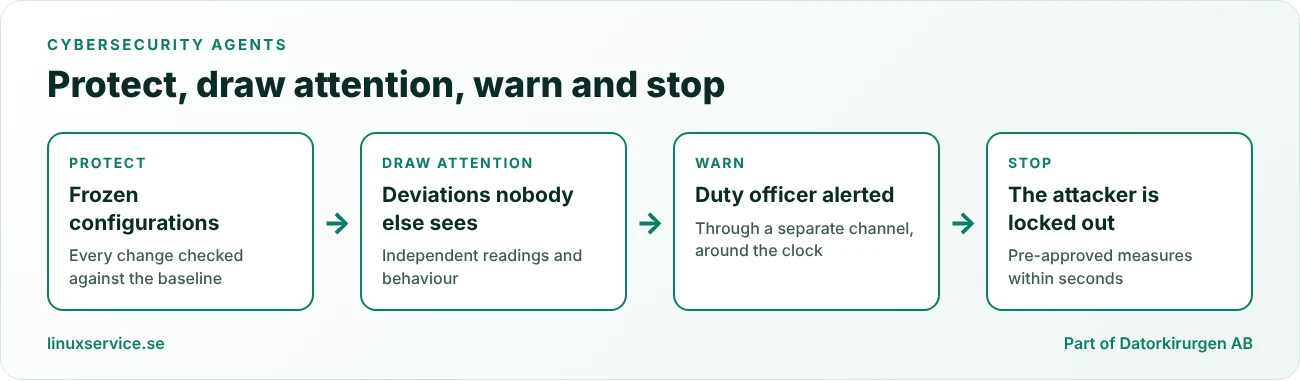
The agents protect by freezing configurations and watching every change. Furthermore, they draw attention to deviations that nobody else sees, for example a supplier who logs in in the middle of the night or a tolerance attack that tests the limits. In addition, they warn the duty officer through a separate channel, and they stop the intrusion with pre-approved measures within seconds. We show how this works in practice in the article on a cyber attack on air traffic control.
Our conviction and our guarantee
Our conviction is clear: an attack should not be able to succeed at a client who has invested in our cybersecurity agents. That is the goal we build the agents for, and that is the responsibility we take. After all, the attacks follow known patterns, and the agents react to every step in the chain before the attacker gets through.
Therefore, we guarantee the following. The agents monitor around the clock and report every deviation. In addition, every alarm reaches a person through a separate channel. The agents carry out the pre-approved protective measures within seconds, and they change nothing without your approval. Moreover, nobody can turn the agents against you, because they can only close doors.
We stand behind the protection against cyber attacks on functions of society
Above all, we never leave a client alone. Every alarm gets our follow-up until we have investigated the cause, and at the slightest attempt we close the way in and make sure that the same method never works again. In addition, we document every attempt for the police and the insurance company, supported by our protocol for forensic investigation.
The difference compared with having no agents is decisive. Without agents, the organisation detects the attack after hours or days, when the damage has already happened. With agents, the attacker is locked out within minutes, the damage stays limited and the traces are secured in the agents’ own logs. You can also read about false flags in cyber attacks and about sabotage of refrigeration systems.
Contact Linux Service about protection against cyber attacks on functions of society
Linux Service, part of Datorkirurgen AB, protects functions of society, businesses and public authorities throughout Sweden. We are not the cheapest, because we deliver the highest and most secure quality. Prices start from 10 000 SEK per hour excluding VAT. The Swedish Security Service publishes its assessments on sakerhetspolisen.se, and Datorkirurgen AB has written about the lack of cyber awareness in Sweden. Therefore, contact us before the next attack, not after it.
Frequently asked questions about cyber attacks on functions of society
The threat and the targets
- Which functions of society are next in line?
- How has the warfare of foreign powers changed form?
- What does NATO membership mean for the threat against Sweden?
- What is a tolerance attack?
- Why is the Swedish Tax Agency on the list?
- Why are insurance companies a target?
- Why is Systembolaget on the list?
- Why are SVT, Sveriges Radio and UR targets?
- Why are daily newspapers a target?
- Is the freezer attack a preparation for larger attacks?
The agents
- How do the cybersecurity agents protect a function of society?
- How do the agents draw attention to a hidden attack?
- Do the agents detect a tolerance attack?
- How do the agents warn the duty officer?
- How do the agents stop an intrusion?
- Can anyone turn the agents against us?
- Do the agents work for banks and insurance companies?
- Can the agents monitor control systems in water and district heating?
- Do the agents react in the middle of the night?
- Do the agents keep traces for the investigation?
Guarantee, price and cooperation
- What is your conviction?
- What do you guarantee?
- Why are you convinced of the protection?
- How do you follow up an alarm?
- Do you help us with the police and the insurance company?
- How quickly are you on site?
- Do you work with public authorities and municipalities?
- What do cybersecurity agents cost?
- Do you work throughout Sweden?
- How do we get started?