
False flags in cyber attacks are a deliberate tool, not a coincidence. Advanced and well-organised attacks, which are usually state operations, leave exactly the traces that the attackers want investigators to find. Linux Service, part of Datorkirurgen AB, explains here how the deception works, and why it decides how an investigation must proceed.
Why attackers plant false flags
Anyone who plans an attack on a country, an authority or an entire industry expects police, security services and security companies to examine every file afterwards. Therefore, the attacker also plans the investigation. The aim is for the traces to point to the wrong country, the wrong group or a harmless culprit, so that the real sender escapes the consequences.
Datorkirurgen AB’s assessment is clear. Sophisticated, complex and well-organised cyber attacks, usually state operations, leave no real traces behind, because the people who carry them out know very well how to avoid it. Instead, the attacker has deliberately placed whatever remains, in order to deceive the police, the investigators and the so-called experts and lead them away from the actual source.
Foreign languages as diversions
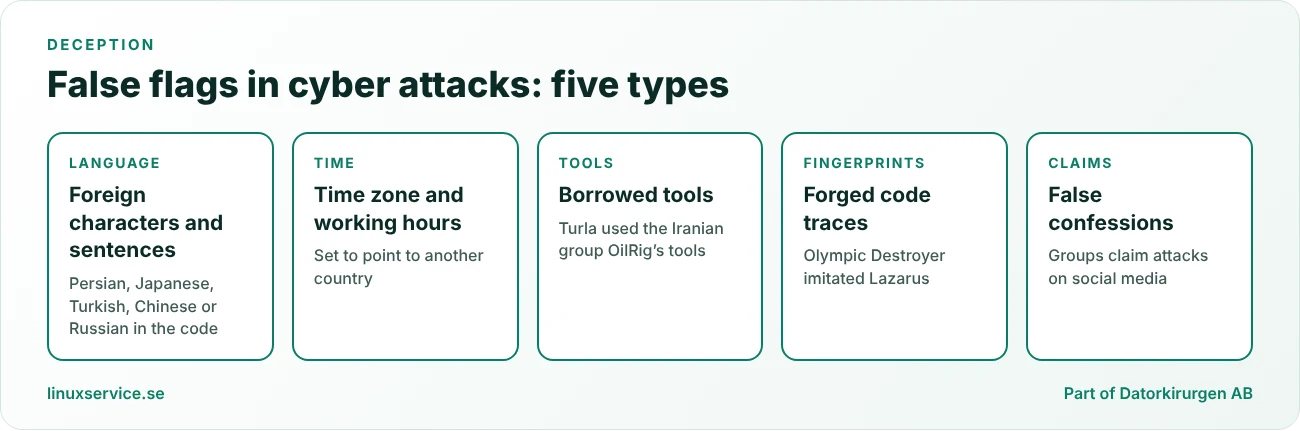
One of the most common tricks is to plant characters or whole sentences in a foreign language, for example Persian, Japanese, Turkish, Chinese or Russian. A comment in the code, an error message or a file name is enough to make an investigator start searching in the wrong part of the world. In addition, the attacker can set the keyboard layout, time zone and working hours so that they match the country that is meant to take the blame.
The Vault 7 leak from 2017 shows that the method is real. According to the source code files that Wikileaks published, the Marble tool contained test examples in Chinese, Russian, Korean, Arabic and Persian, with the aim of making it harder to link malicious code to its real author. A foreign language in a file is therefore no proof of where an attack comes from.
Olympic Destroyer: false flags in cyber attacks on the Olympics
At the Winter Olympics in Pyeongchang in 2018, malicious code knocked out systems around the opening ceremony. The code contained a fingerprint that fully matched the North Korean group Lazarus. When Kaspersky examined the code more closely, however, the fingerprint turned out to be forged and deliberately planted. The United Kingdom later named the Russian military intelligence service GRU, and the United States charged six GRU officers over that attack, among others.
The example shows exactly how the deception works. The most obvious evidence was the false one, and the first analyses therefore pointed the wrong way. Only a thorough examination of how the code was actually built revealed the fraud.
Borrowed tools and false claims
Attackers also borrow other groups’ tools. According to the British NCSC and the American NSA, the Russia-linked group Turla took over tools and infrastructure from the Iranian group OilRig. With them, Turla attacked victims in more than 35 countries, and the attacks looked as if they came from Iran.
Claims on social media work in the same way. After the freezer attack on Swedish shops, two pro-Russian groups claimed responsibility. Such a claim proves nothing about the sender, because it is one of the simplest ways to steer attention. You can find more about the attack in our article on sabotage of refrigeration systems.
Uninformed experts after the attack
Our experience is that the so-called experts always arrive only after the attack, with solutions and suggestions for how it could have been stopped. Moreover, they read the planted traces literally and draw conclusions about language, country and skill. On the same morning as the freezer attack, a security expert on Swedish TV4 guessed that amateurs were behind it, while the refrigeration technician on site stated that the attackers knew refrigeration technology well.
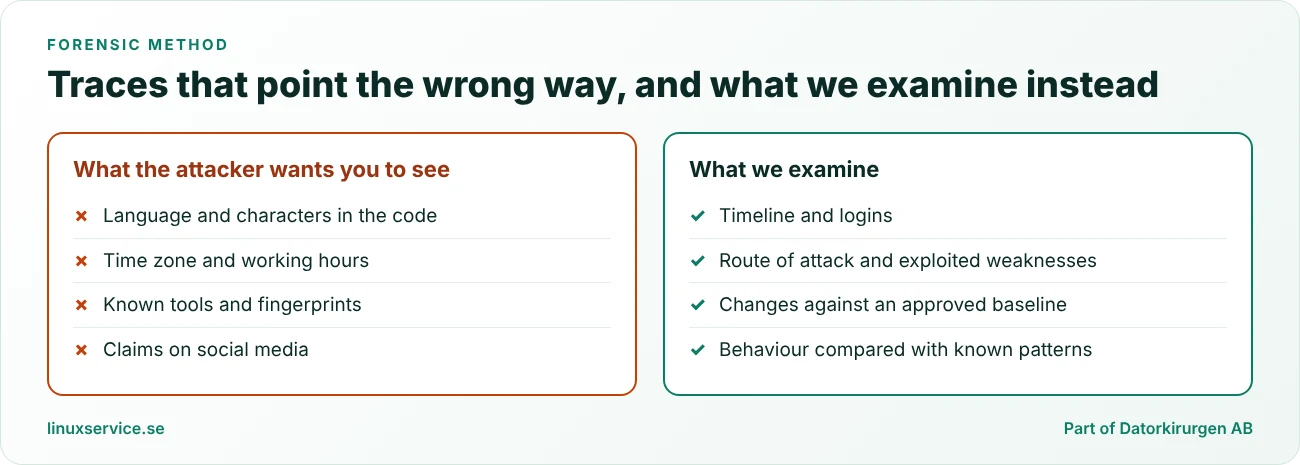
For this reason, asking first who was behind the attack is the wrong question. The decisive questions are how the attacker got in, what the attacker changed and how you stop the next attack before the damage occurs.
How we handle false flags in cyber attacks
We never draw conclusions from languages, time zones or claims. Instead, we secure the timeline, the logins and the changes according to our protocol for forensic investigation, and we compare the behaviour with known attack patterns. In this way, we identify the route of attack and the weaknesses that made it possible, whatever flag the attacker has raised.
Even more important is to stop the attack while it is in progress. Our cybersecurity agents react to what the attacker does, not to who the attacker pretends to be. In the article about a cyber attack on air traffic control, we show how they would have detected and stopped such an attack in the middle of the night.
Contact Linux Service about false flags in cyber attacks
Linux Service, part of Datorkirurgen AB, investigates intrusions and protects control systems and servers throughout Sweden. Prices start from 10 000 SEK per hour excluding VAT. You can also read Datorkirurgen AB’s article on threats from foreign powers. Therefore, contact us before the next attack, not after it.
Frequently asked questions about false flags in cyber attacks
False flags and deception
- What is a false flag in a cyber attack?
- Why do attackers plant false flags?
- Which types of false flags are most common?
- How can a foreign language in the code mislead investigators?
- Why do attackers choose Persian, Japanese or Turkish characters?
- What was the Marble tool?
- What happened with Olympic Destroyer?
- How did Turla take over Iranian tools?
- Does a claim on social media prove who was behind an attack?
- Can time zones and working hours be fake?
Investigation and experts
- How do you investigate an attack with false flags?
- Why do you draw no conclusions from the language in the code?
- What do you secure first after an intrusion?
- How long does a forensic investigation take?
- Can you work together with the police?
- Why do the first analyses often point the wrong way?
- What characterises a state attack?
- How do you tell amateurs from state actors?
- Why do experts often arrive too late?
- Do we get a report that holds up for the insurance company?
Protection, agents and price
- How do we protect ourselves against state attacks?
- How do your cybersecurity agents help?
- Can the agents detect an attack with false flags?
- Do the agents react in the middle of the night?
- Can attackers take over the agents?
- Which systems can you monitor?
- Do you work with control systems and industry?
- What does an investigation cost?
- Do you work throughout Sweden?
- How do we get started?