
A cyber attack on air traffic control can paralyse air traffic in a single night. Here we describe a scenario based on known attacks and methods, and we show how Linux Service, part of Datorkirurgen AB, would have detected and stopped the attack with our own digital cybersecurity agents before any person had even noticed it.
A scenario built on known attacks
The scenario is not made up. During the freezer attack in November 2026, the attackers changed settings in hundreds of refrigeration systems in the middle of the night and silenced the alarms. With Stuxnet, the malicious code played recorded normal values back to the operators while it destroyed the centrifuges. In addition, a ransomware attack on Collins Aerospace in September 2025 knocked out check-in at several European airports, including Heathrow, Brussels and Berlin.
At the same time, the Swedish Transport Agency receives reports of interference with satellite navigation in the Baltic Sea region almost every day. Aviation is therefore already a target, and the methods for a coordinated attack exist. You can find more about state attackers in our article on cyber attacks from foreign powers.
Stuxnet: the model for hidden attacks on control systems
Stuxnet was a computer worm that, according to extensive reporting, the American NSA and CIA developed together with Israel’s Mossad and Israeli signals intelligence in the secret operation Olympic Games. The aim was to sabotage Iran’s uranium enrichment at the Natanz plant and thereby slow down the development of nuclear weapons. The plant was not connected to the internet, and therefore the operation needed a person on the inside. According to the journalists Kim Zetter and Huib Modderkolk, the Dutch intelligence service AIVD, at the request of the CIA and Mossad, recruited an Iranian engineer. In the summer of 2007, he entered Natanz as a mechanic for a front company and introduced the code with a USB stick, either directly into the control system or through an engineer’s computer.
Once inside, the code first collected information about the centrifuges and the ongoing enrichment. After that, it made the centrifuges alternate between excessive and insufficient speeds, so that they wore out and collapsed one after another. At the same time, the malicious code played recorded normal values back in the control room, and the operators therefore saw a plant that worked normally. According to the reports, the worm destroyed up to 1,000 centrifuges before a small antivirus company in Belarus discovered it in June 2010.
The lesson is clear. An isolated plant does not protect against an insider with a USB stick, and the operators cannot trust their screens. That is exactly why our agents compare the values on the screens with an independent reading.
How a cyber attack on air traffic control works
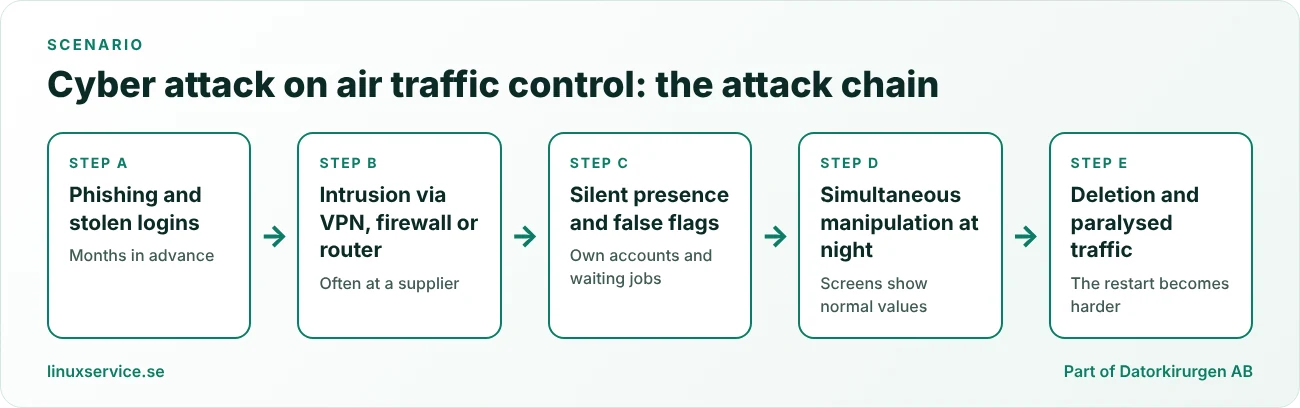
The attack starts months in advance. First, the attackers map suppliers and staff, and then they send targeted phishing emails. With stolen logins, they get in through a supplier’s VPN, a misconfigured firewall or an outdated router. After that, they learn what normal traffic looks like, create their own accounts and add scheduled jobs that wait.
Meanwhile, the attackers plant false flags, for example comments in Persian or Turkish, so that the investigation afterwards goes the wrong way. Then they strike on a night when traffic is light and staffing is low. They manipulate flight data, communication and planning systems at the same time, while the screens keep showing normal values. Finally, they delete data to make the restart harder.
Why no person notices the attack in the middle of the night
In such a scenario, we cannot expect one or more people or controllers in the middle of the night to perceive the attack and dare to stop it. They do not notice that the attack has started, because the attackers control all systems so that they show normal functions. Moreover, nobody dares to shut down air traffic on a hunch, without evidence.
For this reason, the protection must work independently of what the screens show. It must also react in seconds rather than hours, and it must have the mandate to close the attacker’s way in without waiting for a meeting.
How the cybersecurity agents detect the attack
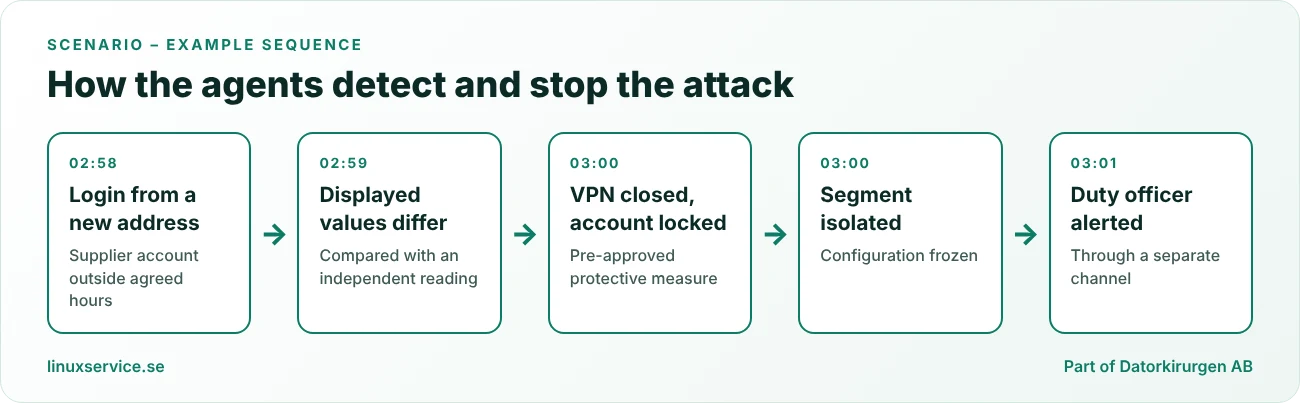
Our cybersecurity agents do not trust the screens. First, they compare what the systems show with an independent source, for example a separate reading of the same data through a route of its own. If the values differ, the agent raises the alarm at once, because recorded normal values never match reality exactly.
Furthermore, the agents monitor behaviour. A supplier who logs in at three in the morning, an account that has never changed the configuration before, changes at several sites at the same time and an alarm that suddenly goes quiet are all clear signs. In fact, the agents treat silence as an alarm in itself: when a signal that should arrive fails to appear, the agent raises the alarm.
How the agents stop a cyber attack on air traffic control
Detection alone is not enough. Therefore, the agents get a short list of pre-approved protective measures that the organisation itself has decided on in advance. The agent closes the supplier’s VPN, locks the account, isolates the affected network segment and freezes the configuration. At the same time, it alerts the duty officer through a separate channel, so that the staff can switch to backup procedures while the attacker is already locked out.
Everything else requires a human decision. The agents can therefore close the attacker’s way in within seconds, but they can never open anything. As a result, they stop the attack in time without becoming a risk to air traffic themselves.
Agents that attackers cannot turn against you
An agent that sees everything is naturally a target in itself. Our agents read with their own accounts that have no write access, run on their own hardened server and can only carry out the protective measures on the list. In addition, an independent guard agent checks them around the clock. We describe the whole design in the article on cybersecurity agents that cannot be hijacked.
The same method would also have stopped the sabotage of refrigeration systems in the shops. The attackers would then have lost their access before the temperature had time to rise. You can also read about false flags in cyber attacks, about protection of control systems and about the functions of society next in line.
Contact Linux Service about protection against a cyber attack on air traffic control
Linux Service, part of Datorkirurgen AB, develops cybersecurity agents for control systems, servers and networks throughout Sweden. Prices start from 10 000 SEK per hour excluding VAT. You can also read Datorkirurgen AB’s article on the lack of cyber awareness in Sweden. Therefore, contact us before the next attack, not after it.
Frequently asked questions about a cyber attack on air traffic control
The scenario and the attack
- Is the air traffic control scenario realistic?
- Which known attacks is the scenario based on?
- How do attackers get into air traffic control systems?
- Why do attackers strike at night?
- How can screens show normal values during an attack?
- What did Stuxnet do to the operators’ screens?
- What happened in the attack on Collins Aerospace?
- What does GPS interference mean for aviation?
- Why do attackers plant false flags?
- Why do staff not notice the attack?
The cybersecurity agents
- How do the agents detect an attack that hides itself?
- What is an independent reading?
- How do the agents handle an alarm that goes quiet?
- Which behaviours do the agents react to?
- What is a pre-approved protective measure?
- How quickly do the agents stop an attack?
- Can the agents close a supplier’s VPN?
- Who decides on the protective measures?
- Can the agents themselves disrupt air traffic?
- How do the agents alert the duty officer?
Security, introduction and price
- Can attackers take over the agents?
- Where do the agents run?
- Which permissions do the agents get?
- Do the agents work with older systems?
- Can the agents monitor several sites at once?
- How long does an introduction take?
- Do you work with industries other than aviation?
- Can you review our suppliers’ remote access?
- What do cybersecurity agents cost?
- How do we get started?