
Cybersecurity agents see everything that happens in your systems, and that is exactly why attackers would like to take them over. Linux Service, part of Datorkirurgen AB, therefore builds our agents so that nobody can turn them against you. Even if an attacker got into the agent’s server, the attacker could not use the agent to open, change or destroy anything.
Why attackers want to take over cybersecurity agents
A monitoring tool often has broad permissions and contact with many systems. Therefore, it becomes an attractive target. In the SolarWinds intrusion in 2020, the attackers slipped a back door into an update of a monitoring program, and thousands of customers installed it themselves. The tool that was meant to protect thus became the way in.
In addition, advanced attackers stay. After the attack on Collins Aerospace, the supplier tried to rebuild the system but found that the attackers were still in the environment. For this reason, we build our cybersecurity agents on the assumption that the attacker may already be inside the network.
The agents read but cannot change
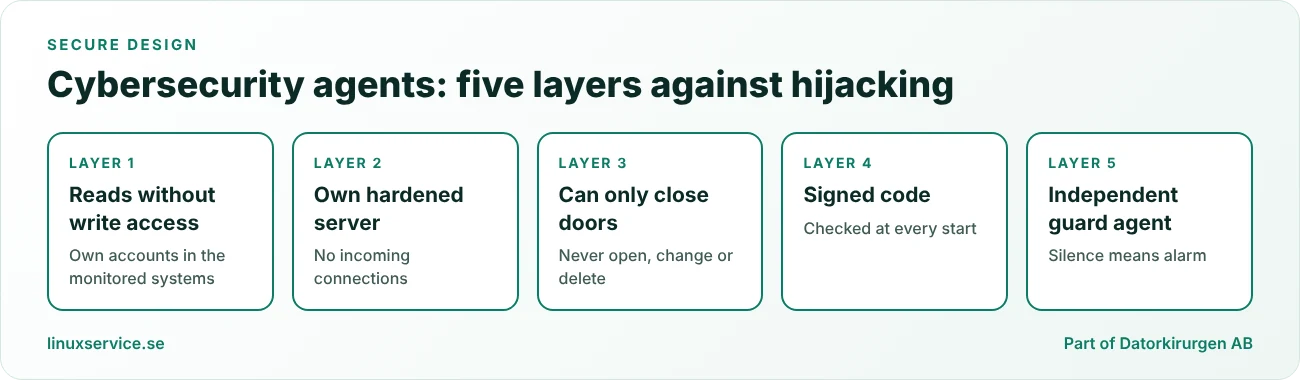
Our agents read logs, settings and measurements with their own accounts, which have no write access in the systems they monitor. They also run on their own hardened server in a network segment of its own. Furthermore, the server accepts no incoming connections and has no remote login open to the outside world. Instead, the agent sends its reports outwards, and nobody can call in to it.
Consequently, there is no door for an attacker to knock on. Anyone who breaks into a control system or an office network cannot reach the agent from there, because the traffic only goes one way.
Cybersecurity agents that can only close doors
To stop an attack in time, the agent may carry out a few protective measures without waiting: close a VPN session, lock an account, isolate a network segment or freeze a configuration. Moreover, the list is fixed, because the organisation decides on it in advance. The agent, on the other hand, can never open a port, create an account, change a set point or delete data.
This means that even a hijacked agent can only do what protects you. In the worst case, it closes a door that should be open, which the duty officer notices and fixes at once. The attacker therefore cannot use the agent as a weapon against you.
Signed code and a guard agent that checks
Every time an agent starts, it checks its own code against checksums that we have signed. If a single line has changed, the agent refuses to run and raises the alarm instead. Furthermore, we never store keys and passwords in plain text, and the reports travel encrypted through a separate channel.
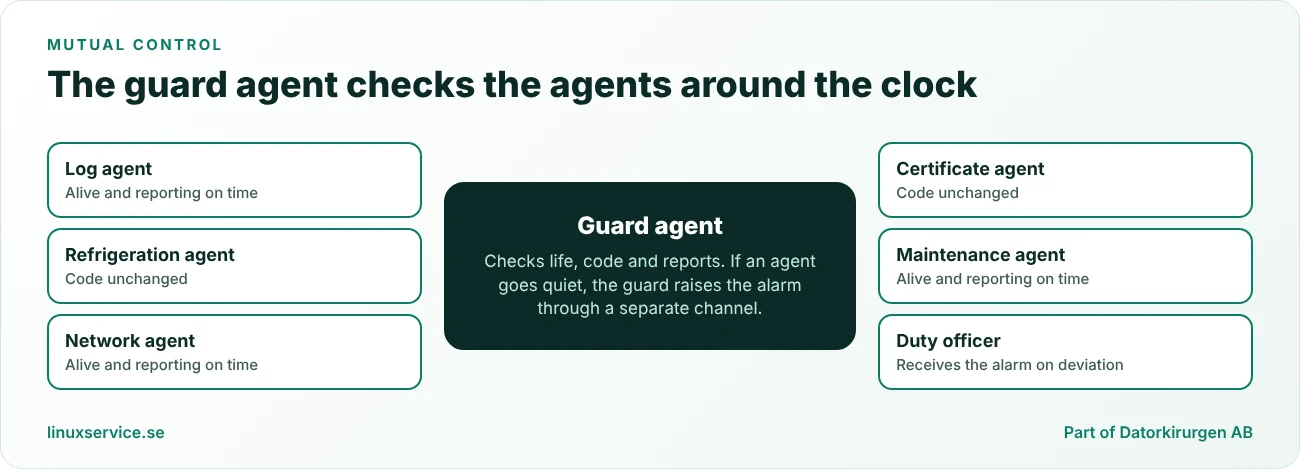
In addition, an independent guard agent watches the other agents. First and foremost, it checks that they are alive, that their code is unchanged and that their reports arrive on time. If an agent goes quiet, the guard raises the alarm. As a result, an attacker would have to knock out several independent systems at the same time and in complete silence, which is ruled out in practice.
People have the final word
All changes beyond the pre-approved protective measures require a human decision. The agent shows exactly what it wants to change and why, first runs a dry run and keeps a log of everything it does. Finally, we write the agents in Bash and Python, so that your own staff can read and review the code. You can find the foundation in the article on security agents for Linux.
Our agents already work every day in our own operations, where they monitor certificates, sites and languages, among other things. Business IT Support, which is also part of Datorkirurgen AB, describes how our agent team works.
From the freezer attack to air traffic control
The same agents would have stopped the sabotage of refrigeration systems in the shops, and they would have stopped a cyber attack on air traffic control before any person had noticed it. After all, they react to what the attacker does, not to who the attacker pretends to be, and therefore false flags in cyber attacks make no difference to them. We present the targets next in line in the article on cyber attacks on functions of society.
Contact Linux Service about cybersecurity agents
Linux Service, part of Datorkirurgen AB, develops cybersecurity agents for servers, control systems and networks in AWS, Oracle Cloud, Azure, Google Cloud and your own data centres. Prices start from 10 000 SEK per hour excluding VAT. In addition, the Center for Internet Security publishes guidelines for secure configuration. Therefore, contact us before the next attack, not after it.
Frequently asked questions about cybersecurity agents
Protection against hijacking
- Can an attacker take over a cybersecurity agent?
- Why are monitoring tools a target?
- What happened in the SolarWinds intrusion?
- Which accounts do the agents use?
- Why do the agents have no write access?
- Why does the agent’s server accept no connections?
- What does it mean that traffic only goes one way?
- Which protective measures may the agent carry out on its own?
- What can the agent never do?
- What happens if someone changes the agent’s code?
Guard agent and control
- What does the guard agent do?
- How do you notice that an agent has gone quiet?
- How do you store keys and passwords?
- How do the agents send their reports?
- Why does the agent run a dry run first?
- Do the agents keep a log of everything they do?
- Can our staff review the code?
- Who approves changes?
- How quickly do the agents react?
- Which languages do you write the agents in?
Use, price and introduction
- Which systems can the agents monitor?
- Do the agents work for control systems and refrigeration plants?
- Can the agents protect air traffic control and transport?
- Do the agents work in the cloud?
- How many servers can one agent monitor?
- Do you use the agents yourselves?
- Can we decide the list of protective measures?
- What do cybersecurity agents cost?
- How long does an introduction take?
- How do we get started?