
Forensic investigation after intrusion, industrial espionage and sabotage. Linux Service and Datorkirurgen AB secure evidence and prevent the next attack.
Forensic investigation according to protocol
On the night before 2 November 2026, the temperature in the refrigerated and freezer counters of about thirty Swedish grocery shops rose to around 50 degrees. The shops had to discard goods worth millions of kronor. The same type of attack had hit hundreds of shops in France three weeks earlier. Therefore, industrial sabotage is no longer a theoretical scenario, but a real risk for every business with connected technology.
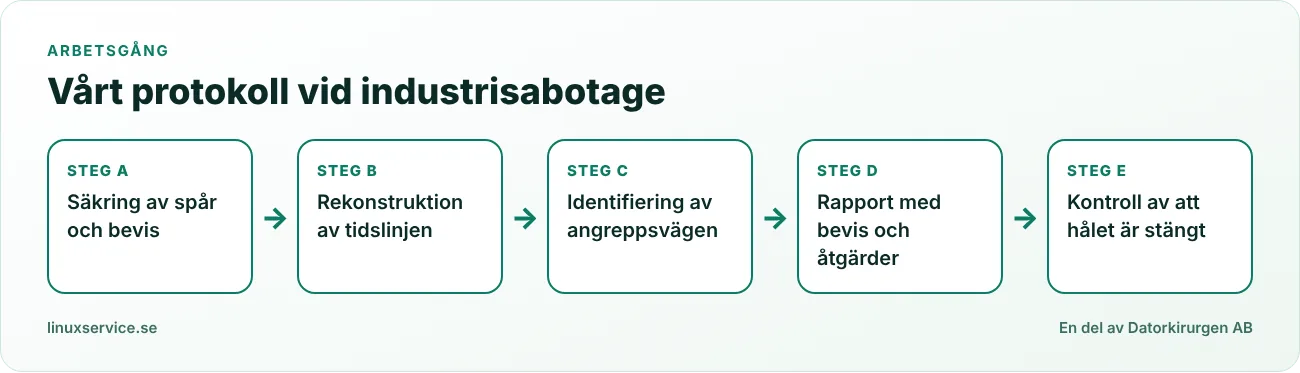
Linux Service and Datorkirurgen AB carry out forensic investigations after intrusion, industrial espionage and sabotage. We follow a fixed protocol in three parts: securing traces, mapping the attack path and analysing the vulnerabilities. The protocol makes the investigation traceable and reproducible. In addition, the evidence holds up for a police report, an insurance claim or a court case.
The threat: sabotage that destroys real values
Industrial espionage is first and foremost about stealing knowledge, drawings, source code and business information. Industrial sabotage, on the other hand, aims to cause physical or financial damage. Both now target control systems for refrigeration, power, water, traffic and production. However, they also target business systems at car dealers, law firms, dental care and hospitals.
According to SVT, a shop in Sjöbo discarded goods worth up to one million kronor, and a warehouse in Västra Frölunda goods worth around three million kronor. In addition, the Swedish Security Service points out Russia, China and Iran as the biggest threats to Sweden. The authority has also seen attempts at destructive cyber attacks. Read more in our article on cyber attacks from foreign powers.
Protocol part 1: securing traces and evidence
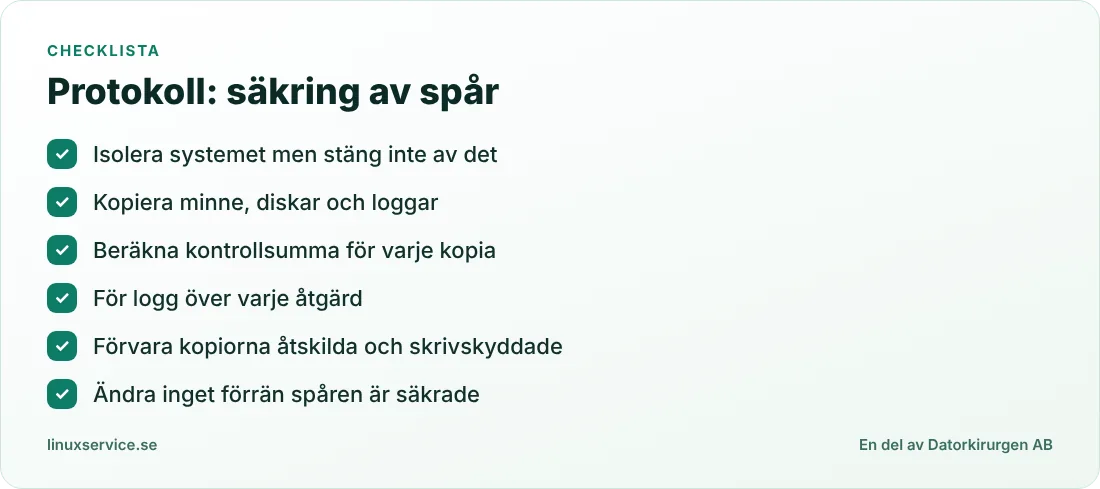
The first step decides whether the investigation is possible at all. Therefore, we change nothing until we have secured the traces. We take copies of logs, memory and disks and calculate a checksum for each copy. The checksum later shows that nobody has changed the material. At the same time, we keep a log of every action, with time, person and purpose.
A common mistake is to restart the system or reinstall it directly. In fact, the content of the memory then disappears, and new data overwrites the attacker’s traces. Instead, we isolate the affected system from the network, but leave it running until we have secured the evidence.
Protocol part 2: mapping the attack path
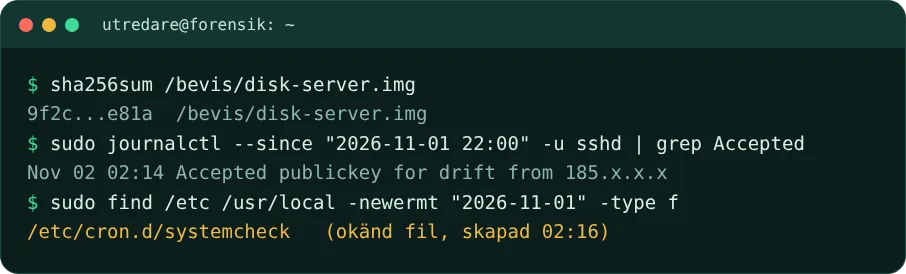
After that, we reconstruct the sequence of events. We go through sign-ins, changed files, new accounts, scheduled jobs and network traffic. Then we place each event on a timeline. In this way, it becomes clear when the attacker got in, which path the attacker chose and what happened next.
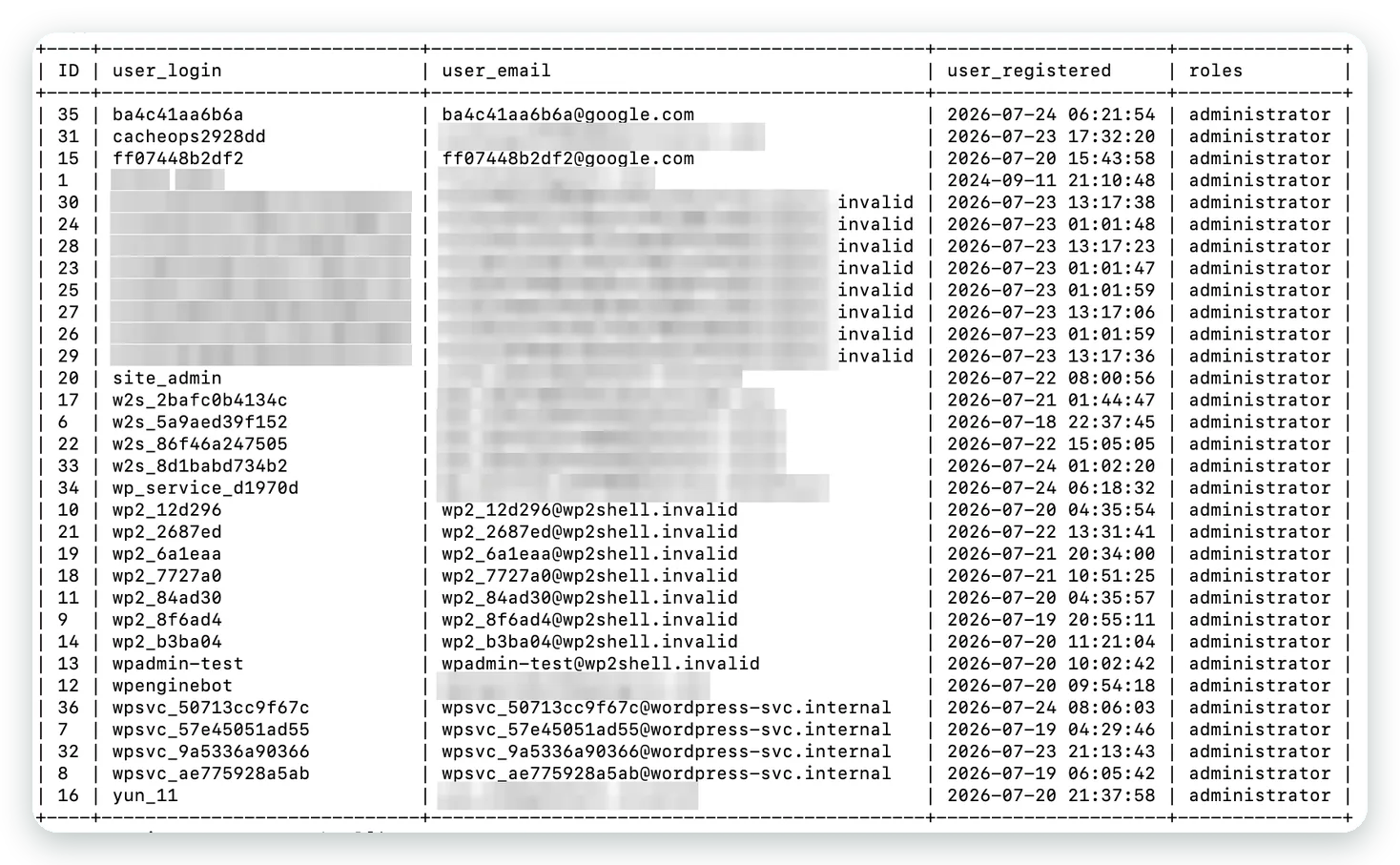
In one of our investigations, the attacker had created more than thirty administrator accounts. The accounts were hidden among the real users, and they gave the attacker continued access even after the administrator had fixed the first fault. In other words, without a complete mapping the intrusion would have continued. We describe the work in more detail in the article on forensics on Linux servers.
Protocol part 3: vulnerability analysis and actions
The last step answers the question that management asks: how could this happen? We point out the vulnerability that the attacker used and the weaknesses that made it possible to exploit. For example, it may concern a default password, a connected controller without a firewall, a forgotten account or software that lacked updates. After that, we propose actions in order of priority.
The report then describes the findings, the evidence and the conclusions in a way that both technical staff and management can use. You can also hand it to the police, insurance companies and supervisory authorities. Finally, we check that the actions are in place and that the attacker no longer has access.
Arrogance: an underestimated security risk
Our experience is that security at many Swedish authorities, organisations and businesses fails for a reason that reports rarely mention: arrogance. People are convinced that they are already the best at protecting themselves, or that they are already protected. Firewalls, antivirus programs and agreements with suppliers replace a real review. In addition, many see the person who points out weaknesses as troublesome instead of as an asset. Datorkirurgen AB describes the same pattern in the article on the lack of cyber awareness in Sweden (in Swedish).
The consequence is predictable. Only after the intrusion, the industrial espionage or the industrial sabotage do they bring in so-called experts. These often state: “Yes, we knew about this. Yes, we had expected this.” However, anyone who knew that the weaknesses existed and that the attack was imminent, without either preventing or stopping it, has not done the work that an expert should do. Knowledge that only explains the damage afterwards protects nothing. Therefore, Linux Service and Datorkirurgen AB work in the opposite order: we look for the weaknesses before the attacker finds them.
Experience from similar incidents
Several of this year’s incidents show exactly this pattern, where the warnings were there long before the damage occurred:
Refrigeration systems in shops. In August 2026, according to EFN, security researchers published a report on vulnerabilities in Danfoss control systems for refrigeration, including a hidden authentication mechanism. In October, attackers manipulated the refrigeration in hundreds of French shops via such systems, and in November about thirty shops in Sweden suffered the same thing. The way in was no mystery: the attackers used the refrigeration controllers’ own remote functions, which were reachable outside the retail chains’ central networks, and the vulnerabilities were known in advance.
The heating plant in western Sweden. In the spring of 2025, a group with links to Russian intelligence tried to carry out a destructive attack on a heating plant. Minister for Civil Defence Carl-Oskar Bohlin stated this in April 2026. The plant’s safety systems stopped the attack, which shows that preventive protection works when it actually exists.
The Polish energy system. In December 2025, attackers tried to delete data in systems for combined heat and power plants and renewable energy. The safety system detected and stopped the attack before the power went out.
Car dealers in the USA. An extortion attack on the supplier CDK Global knocked out systems at thousands of car dealers at the same time, since they all depended on the same platform.
The former consultant. In Singapore, a former IT consultant deleted 180 virtual servers at his previous employer, since nobody had removed his access.
What all the cases have in common is that the risks were known. What decided the outcome was whether someone had acted before the attack or not. The café in Stockholm that the freezer attack hit did not even know that the freezer was connected to the internet. It is exactly such gaps that a preventive review finds.
Knowledge gaps in platforms and backups
In our assignments, we see the same weaknesses again and again. Authorities, businesses and industries often lack deep knowledge of how Microsoft Windows, Apple devices, Android devices and platforms work and how to protect them. The same applies in particular to security systems based on Linux, for example firewalls, surveillance cameras and controllers. Suppliers configure the systems incorrectly, accounts get excessive permissions and updates do not happen. In addition, the threat often comes from within, which Datorkirurgen AB describes in the article on cyber security threats from your own employees (in Swedish). Consequently, the door is open to anyone who looks.
In addition, knowledge of snapshots, blob object storage and backups is often inadequate. Backups do not exist at all, sit in the same network as production or can be deleted with the same account. Above all, few have tested the restore against a real scenario. A backup that nobody has restored in an exercise is therefore only an assumption. Read more about backups that the attacker cannot reach.
A dress rehearsal for larger coordinated attacks
Datorkirurgen AB’s assessment is that attacks such as the freezer attack, despite the extensive damage, are tests and preparations for considerably larger and coordinated attacks. The aim of such attacks is to strike several authorities, businesses, industries and functions of society at the same time, and thereby sabotage and paralyse cities and the whole country. The fact that nobody has named a sender is a hallmark of attacks of this calibre, because the attackers deliberately plant false flags. Two pro-Russian groups claimed the attack, but such a claim proves nothing about the real source. The Swedish Security Service, however, has reported that it has seen attempts at destructive cyber attacks from Russia against Sweden. In addition, at the end of December 2025, attackers whom the security company ESET links to the Russian group Sandworm tried to knock out parts of the Polish energy system with malicious code that deletes data. The safety system stopped the attack before the power went out, but it shows the capability that the attackers already have.
In our experience, foreign powers are often behind and coordinate attacks of this kind. The states’ security services plan them long in advance and fund them with state budgets. Therefore, it is not enough to react once the attack happens. Read more in our article on cyber attacks from foreign powers and from Datorkirurgen AB about the threats from foreign powers (in Swedish).
Our view: the attacks can be prevented
Linux Service and Datorkirurgen AB take the opposite view. You can prevent and stop most of these intrusions with known and proven methods. This requires an inventory of all connected equipment, segmentation of the network, strong authentication, updates and monitoring of unusual activity. In addition, none of this is new technology. However, it requires that someone actually does the work before the attacker does theirs.
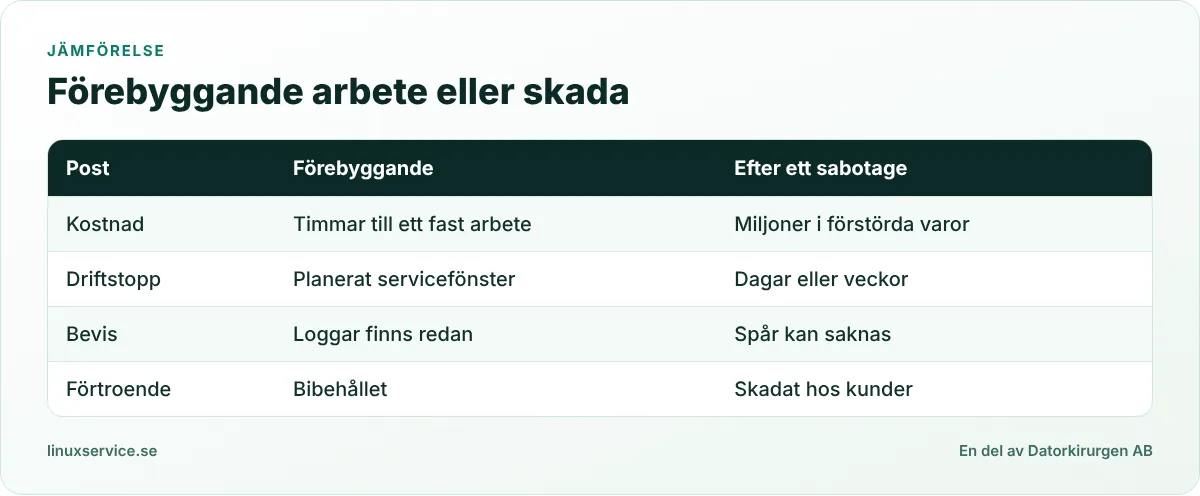
The price of a forensic investigation in relation to the damage
Our prices start from €1,300 per hour excluding VAT. It is a low price in relation to what is at stake, and the comparison is clear. A single sabotage of the refrigeration systems cost a shop up to one million kronor and a warehouse around three million kronor in one night. The cost of preventing and stopping the same attack is a fraction of this. In addition, the risk of downtime, lost customers and claims from insurance companies decreases.
Contact us for a forensic investigation
Contact us directly if you suspect intrusion, industrial espionage or sabotage. Preferably, change nothing until we have secured the traces. We work remotely across Sweden and on site in Stockholm, and we can also carry out a preventive review before something has happened. In short, it is cheaper to close the hole today than to investigate the damage tomorrow.
Frequently asked questions about forensic investigation
Questions about forensic investigation
- What is a forensic investigation?
- What distinguishes industrial espionage from industrial sabotage?
- When should you order a forensic investigation?
- Why should you not restart an affected system?
- How do you secure the evidence?
- What is a checksum?
- Can we use the evidence for a police report?
- Can we use the report with the insurance company?
- How long does an investigation take?
- Do you work together with the police?
Attacks, vulnerabilities and protection
- How did the attackers get into the refrigeration systems?
- Which systems are most exposed to sabotage?
- Can attacks come from foreign powers?
- How do you find hidden accounts and back doors?
- Can you investigate intrusions in control systems?
- Can you investigate intrusions in business systems?
- How do you prevent industrial espionage?
- How do you prevent industrial sabotage?
- Are a firewall and antivirus enough?
- Can you review our suppliers’ access?
Price, confidentiality and contact
- What does a forensic investigation cost?
- Why does preventive work cost less than the damage?
- Do you handle the information confidentially?
- Can you sign a confidentiality agreement?
- Do you work remotely?
- Do you come on site?
- Do you help public authorities?
- Do you help smaller businesses?
- How quickly can you start?
- What should we do before you arrive?