
Foreign powers are behind long-term cyber attacks, industrial espionage and sabotage. This is how you detect and stop state-sponsored attacks on businesses.
Foreign powers according to the Swedish Security Service
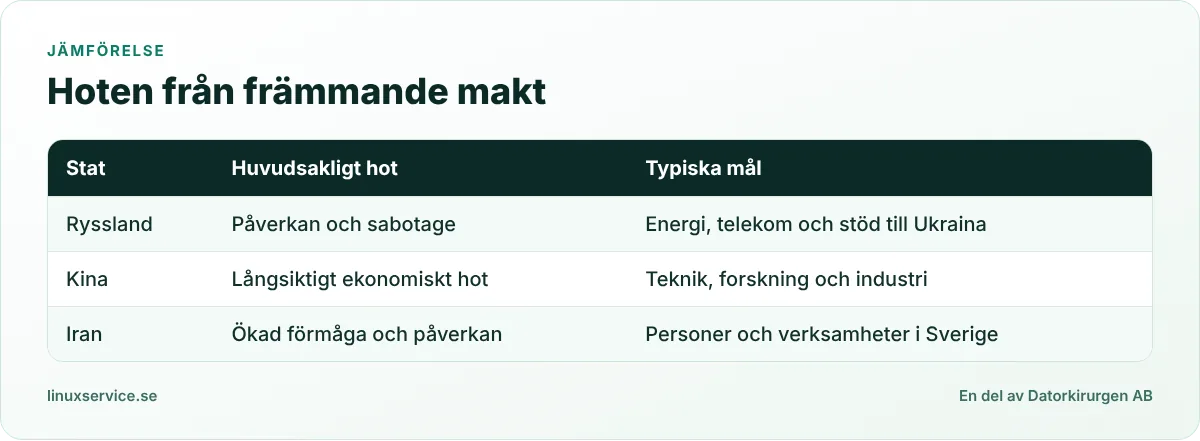
In its situation report for 2025–2026, the Swedish Security Service states that foreign powers carry out extensive security-threatening activities against Sweden. Russia, China and Iran are the biggest threats. The report describes Russia as more willing to take risks than before, and the authority has seen attempts at destructive cyber attacks from there. At the same time, China is the long-term threat to Swedish economic security, and in addition Iran has increased its capability.
The Swedish Security Service also emphasises that Swedish companies are far ahead in strategic technology. Therefore, foreign powers have a strong interest in stealing it, buying it up or gaining access to it in other ways. In other words, the threat does not only concern the defence industry. It also covers subcontractors, research companies, consultants and technical service companies.
Attacks from foreign powers are planned long in advance
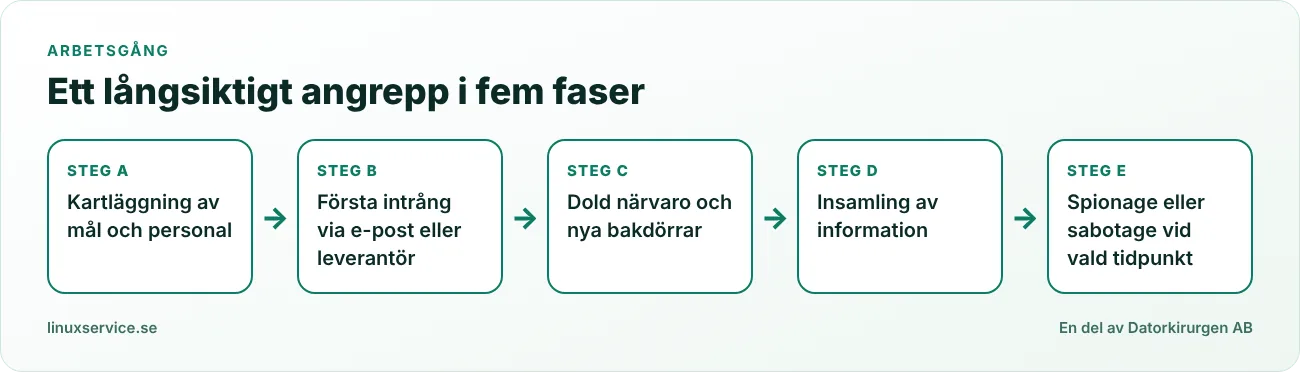
State-sponsored attacks differ from ordinary crime. Behind them, there is often an intelligence service with its own budget, its own staff and a long planning horizon. The attacker can get into a network and then wait for months or years. Meanwhile, the attacker maps systems, accounts and suppliers. Only when it suits the political purpose does the attacker use the access for espionage or sabotage.
The Swedish Security Service has also seen examples of how foreign powers use Swedish infrastructure as a base for attacks on other countries. In other words, a server at a Swedish company can become a springboard against someone else, without the owner knowing about it. We also describe the background in Datorkirurgen’s article on the threats from foreign powers (in Swedish).
Industrial espionage: knowledge as the target
Industrial espionage is usually silent. Nothing stops working, and the attacker demands no ransom. Instead, drawings, source code, bids and research results disappear over a long period. The damage only shows when a competitor in another country launches a similar product or wins a tender with a suspiciously exact bid. Therefore, the protection also needs to detect unusual data transfers, not just stop malware.
Sabotage and destructive cyber attacks
Sabotage aims to create disruption and anxiety. It may concern power grids, waterworks, transport or the food supply. The freezer attack on Swedish shops in November 2026 is an example of the damage that an attack on connected control systems can cause. The method is known and shows what a well-organised attacker achieves, while the sender hides behind deliberately planted false flags. Read more about protection of control systems.
Foreign powers and the supply chain
An attacker with state resources often chooses the weakest link instead of the final target. Therefore, attackers like to target a subcontractor, an IT consultant or a service company with access to several clients. Via the supplier, the attacker then reaches many organisations at once. In addition, the freezer attack showed how a shared control system at many shops can become a shared vulnerability. Consequently, it is not enough to protect your own environment. You also need to know which suppliers have access, how they sign in and what the agreements require of them. We go through this together with you and propose requirements that you can set in the next procurement. In this way, the risk that an attacker gets in via someone else decreases.
How to detect long-term intrusions
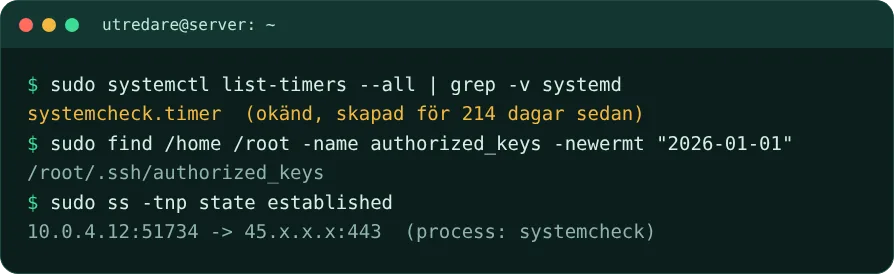
A state-sponsored attacker tries to stay invisible. Therefore, the traces lie in the details: scheduled jobs that nobody recognises, new SSH keys, accounts that sign in at unusual times and outgoing traffic to unknown addresses. As a result, we go through such traces systematically, both in Linux and Unix environments and in cloud services. In addition, we compare them with known signs of attacks from established groups. If we find traces, we secure them first, so that they hold up as evidence.
Protection against attacks from foreign powers
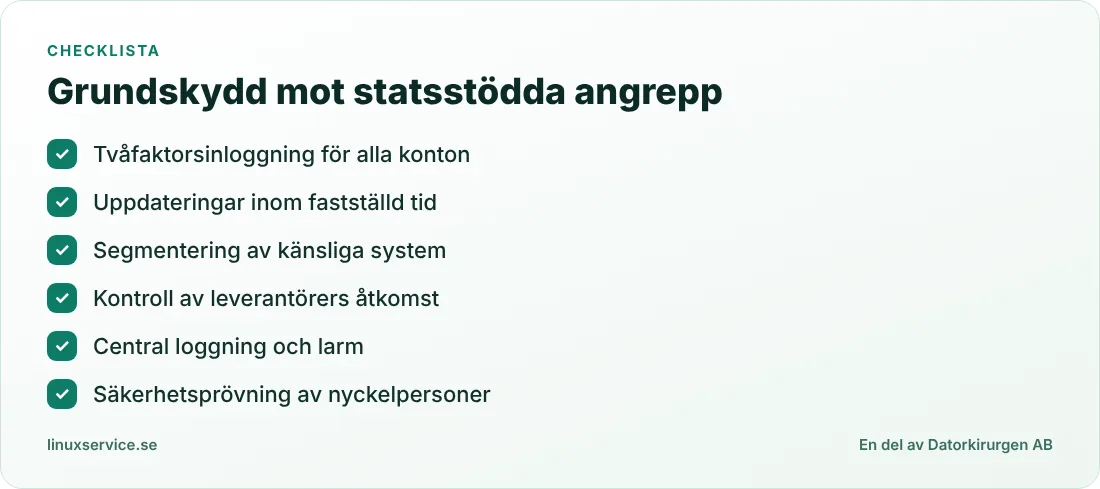
The basic protection is the same as against other attackers, but you must implement it consistently. Among other things, it concerns two-factor sign-in for all accounts, updates, segmentation, control of the access that suppliers have and central logging. In addition, there is security vetting of staff in sensitive roles, since foreign powers also try to recruit insiders. We describe this in the article on insider threats.
At the same time, it is important to understand that state-sponsored actors rarely choose the most obvious target. Instead, they often attack a smaller supplier, a consultant or a subsidiary with weaker protection, and from there they move on to the main target. Therefore, our review also covers the suppliers’ access and the services that share accounts or networks with you.
Why the warnings are not enough
The Swedish Security Service and the government have repeatedly warned that organisations with critical infrastructure should assume that they are targets. Despite this, we see in our assignments that many organisations continue as before. In our experience, the reason is often arrogance, that is, the conviction that you are already the best at protecting yourself. Once the attack has happened, the experts brought in state that the threat was known. However, an expert who knew about the threat without preventing it has not done the job, and therefore preventive work is the very core of what we do.
Contact Linux Service
Linux Service and Datorkirurgen AB help businesses and authorities map, prevent and investigate attacks from foreign powers. Prices start from €1,300 per hour excluding VAT. Compared with lost technology, lost business and damaged trust, this is a low cost. Therefore, contact us for a review of your protection.
Frequently asked questions about foreign powers
Questions about foreign powers
- Which countries are the biggest threats to Sweden?
- What does the Swedish Security Service say about cyber attacks?
- What does state-sponsored attacks mean?
- Why are the attacks planned long in advance?
- How are state-sponsored attacks funded?
- Which industries are most exposed?
- Can small companies be targets?
- Can our server be used against other countries?
- Does anyone know who was behind the freezer attack?
- What is the difference between espionage and sabotage?
Detection and investigation
- How do you notice industrial espionage?
- Which traces does a state-sponsored attacker leave?
- How long can an attacker stay hidden?
- Can you search for hidden back doors?
- Can you review cloud services?
- Can you investigate intrusions in Unix systems?
- Should we contact the Swedish Security Service if we suspect an attack?
- Can you hand the evidence to the police?
- How do you secure the traces?
- How long does an investigation take?
Protection and price
- Which basic protection do we need?
- Is two-factor sign-in enough?
- How do we check the suppliers’ access?
- Do we need security vetting of staff?
- Can you hold training for management?
- Can you monitor our systems?
- Do you work with public authorities?
- Do you work remotely?
- What does a review cost?
- How quickly can you start?