Sabotage of refrigeration systems hit shops in Sweden and France in 2026. This is how the attack worked, and how you protect refrigeration and freezer systems against intrusion.
The freezer attack on Swedish shops
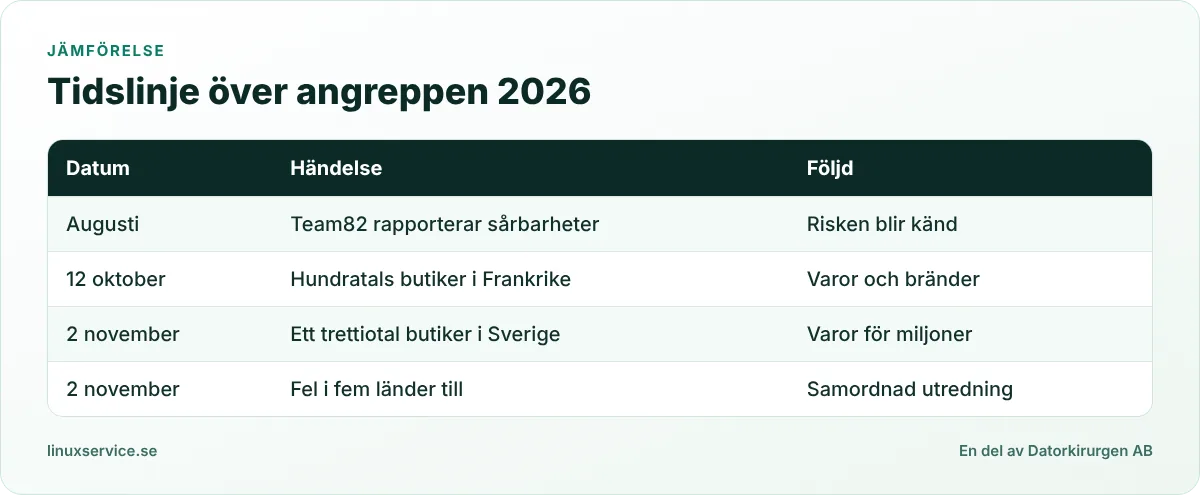
On the night before Monday 2 November 2026, about thirty Swedish grocery shops had faults in their refrigerated and freezer counters. According to SVT, this concerned 23 Ica shops, seven Coop shops and a warehouse that Axfood uses for home deliveries. In several places, the temperature rose to around 50 degrees. Axfood discarded chilled and frozen goods worth around three million kronor, and an Ica shop in Sjöbo goods worth up to one million kronor.
A café in central Stockholm also suffered the fault. There, the defrosting started in the freezer room, and the heat triggered the sprinkler system. As a result, the owner had to throw away the whole stock of dairy and meat. In addition, the owner did not know that the refrigeration and freezer system had a connection to the internet. At the same time, reports came of similar faults in Belgium, Luxembourg, Ireland, Estonia and the Netherlands. Police Region South now coordinates the reports, and the police believe that many cases are unreported.
Sabotage of refrigeration systems hit France first
Three weeks earlier, on 12 October 2026, hundreds of French shops suffered the same type of attack. The attack hit between 150 and 200 Intermarché shops, as well as almost a hundred shops within Coopérative U and about eighty Carrefour shops. The attackers set the refrigeration systems to defrost mode, and the temperature rose to around 50 degrees for several hours. In some shops, fires also broke out. The Paris prosecutor’s office opened an investigation through its cybercrime unit.
According to several media, the attack targeted control systems from the Danish manufacturer Danfoss. In addition, the French cybersecurity agency has stated that the attack also concerned systems from Copeland and Dixell. Already in August, researchers at Team82 had reported vulnerabilities in Danfoss systems, including a hidden authentication mechanism. In other words, researchers knew about the vulnerability months before the attack.
How sabotage of refrigeration systems works
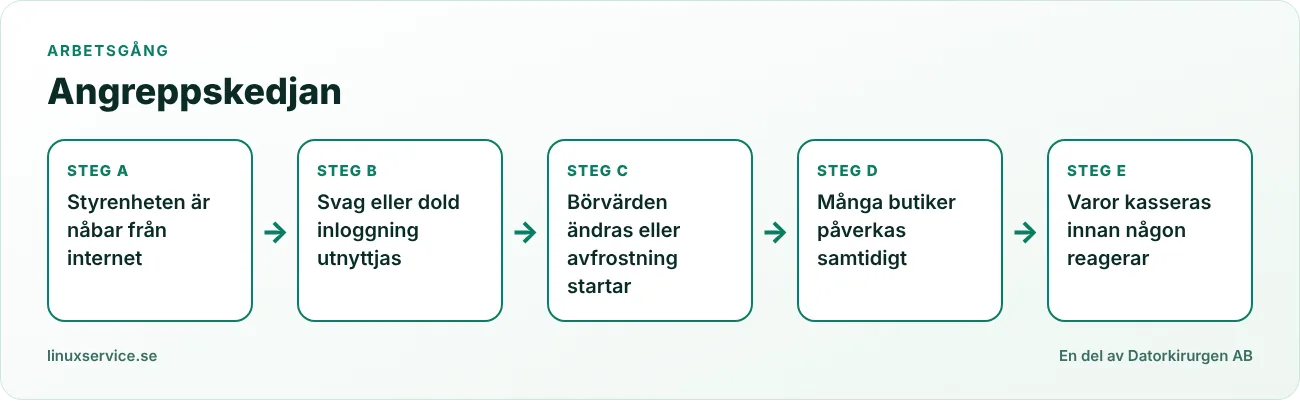
Modern refrigeration and freezer systems have a controller that refrigeration technicians can reach remotely. The remote access is practical for service and alarms. However, if the controller is reachable from the internet, has a default password or lacks updates, an attacker can also reach it. After that, it is enough to change setpoints or start defrosting in all shops at the same time.
It is precisely the simultaneity that makes the attack so costly. Staff notice a single faulty freezer and fix it themselves. When hundreds of systems become warm in the middle of the night, on the other hand, nobody has time to react before the goods are already ruined. Therefore, the security measures must be in the network and in the control system, not in the shop’s routines.
Sabotage of refrigeration systems exploits unknown connections
Often an external refrigeration company installs and maintains the systems. The technician connects the system to see alarms and change settings, but it rarely appears in the shop’s IT documentation. As a result, nobody is responsible for its security. The shop’s IT department does not know about the equipment, and the refrigeration company does not see it as an IT matter. The same pattern exists in buildings, warehouses, restaurants and industries.
How to protect yourselves against sabotage of refrigeration systems
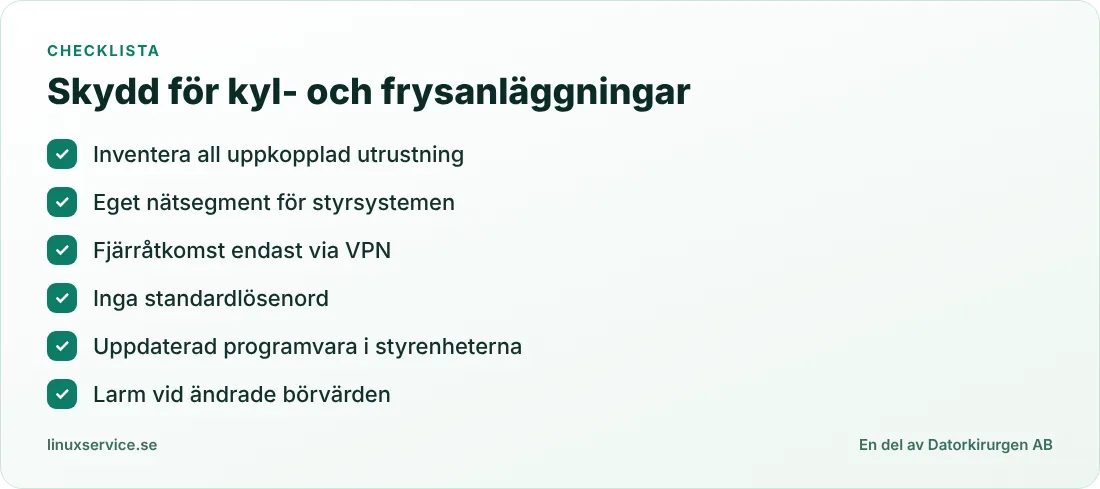
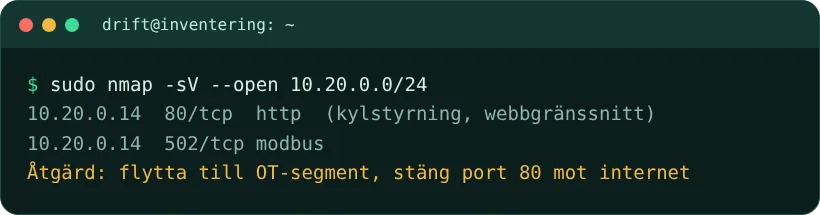
The first step is an inventory of all connected equipment, including what suppliers have installed. After that, we move the control systems to a separate network segment without direct access from the internet. Instead, the remote access goes via a VPN with strong authentication and logging. We also change default passwords, update the software and set up alerts when someone changes setpoints outside working hours. Also read about hardening Linux servers, which builds on the same principles.
A forensic investigation after sabotage
If the attack has already happened, you should therefore not reset or replace the controllers before someone has secured the traces. In fact, the logs in the controller, in the firewall and at the refrigeration company show when someone made the changes and from where. We secure this information according to our protocol for forensic investigation. After that, we close the attack path and check that no further devices are accessible.
Insurance, liability and documentation
After sabotage, questions about liability quickly arise. The insurance company wants to know what happened, and in addition it may become relevant to claim compensation from a supplier. Therefore, you need documentation that shows the sequence of events, which settings the attacker changed and whether basic protection was in place. At the same time, the police need a basis for their investigation. In other words, a forensic report gives both support in the claim and a basis for improving the protection. Moreover, with a preventive review you already have the documentation when something happens.
The warnings were there, but nobody acted
The freezer attack is a clear example of what we often see: experts knew about the weaknesses long before the damage occurred. Security researchers had described the vulnerabilities in the refrigeration controllers already in August, and the attacks in France happened three weeks before the Swedish ones. Even so, many systems were still reachable from the internet. Our experience is that arrogance and overconfidence in your own protection often lie behind this, since people assume that the supplier or someone else has already taken care of security. Therefore, we carry out a preventive review before the attack happens, instead of explaining it afterwards.
We know how sabotage of refrigeration systems works
The basics are known, and they are the same in every attack of this kind: staff’s lack of knowledge, the wrong choice or the wrong configuration of firewall and VPN, outdated computers, routers and networks, and remote access that nobody monitors. The attackers therefore needed no malicious code. The two pro-Russian groups that claimed the attack wrote themselves that they simply exploited the integrated systems.
The refrigeration technician on site described how the temperature was set to 48 degrees, how the system defrosted again and again and how he could not log in. The attackers thus had full control, and according to him they knew refrigeration technology well. Worst of all, however, are the uninformed experts, who always come up with solutions and suggestions for how the attack could have been stopped only after cyber attacks. On the same morning, a security expert on Swedish TV4 guessed that amateurs were behind it.
False flags hide the sender
Advanced, complex and well-organised cyber attacks, usually state operations, deliberately plant diversionary traces. For example, the attackers insert characters or sentences in Persian, Japanese or Turkish to lead the police, the investigators and the so-called experts away from the actual source. The people who carry out such attacks know very well how to avoid leaving traces.
A claim on social media therefore proves nothing about the sender. We describe how the deception works, with real examples from the Olympics in Pyeongchang and from the group Turla, in the article on false flags in cyber attacks.
How our cybersecurity agents would have stopped sabotage of refrigeration systems
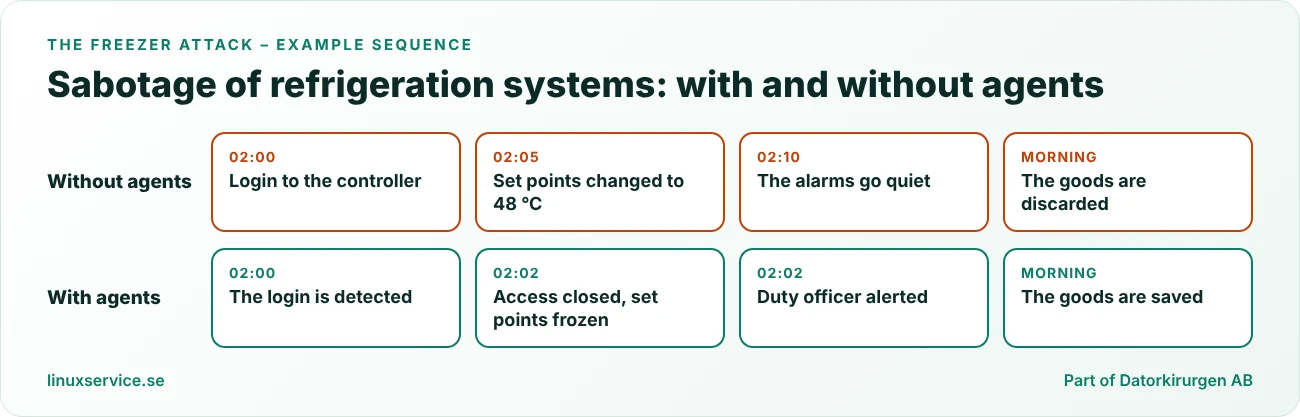
Our cybersecurity agents would have detected the attack within a few minutes. They would have seen a login to the refrigeration controller from a new address in the middle of the night, changed set points outside agreed hours and changes in many shops at the same time. In addition, the agents treat an alarm that goes quiet as an alarm in itself, and they compare the controller’s values with an independent temperature sensor.
After that, the agents would have stopped the attack with pre-approved protective measures. They close the remote access, lock the account in the firewall, freeze the set points and alert the duty officer through a separate channel. Since the temperature rose over several hours, the attacker would have been locked out long before the goods were ruined. We apply the same method to a cyber attack on air traffic control.
Nobody can turn the agents against the shop
Our agents read with accounts that have no write access, run on their own hardened server that accepts no connections and can only close doors, never open them. In addition, an independent guard agent checks that the agents are alive and that their code is unchanged. We describe the whole design in the article on cybersecurity agents that cannot be hijacked.
Contact Linux Service
Linux Service is part of Datorkirurgen AB, which has also written about the lack of cyber awareness in Sweden (in Swedish). We work with the protection and investigation of control systems across Sweden. Prices start from €1,300 per hour excluding VAT. It is a small cost compared with goods worth millions that an attack can destroy in a single night. Therefore, contact us before the next attack, not after it.
Frequently asked questions about sabotage of refrigeration systems
Questions about the freezer attack
- What happened in the freezer attack in November 2026?
- Which shops had problems in Sweden?
- Which countries had problems?
- How high did the temperature in the freezers become?
- Which systems did the attackers target in France?
- Did anyone know about the vulnerability before the attack?
- Who investigates the attacks in Sweden?
- Does anyone know who was behind them?
- Why did the sprinkler go off at the café?
- Can the same attack happen again?
Technology and vulnerabilities
- How does the control in a modern refrigeration system work?
- Why are refrigeration systems connected to the internet?
- What is a setpoint?
- What is a network segment?
- Is it enough to change passwords?
- How often should you update the controllers?
- Can older refrigeration systems be more secure?
- Who is responsible for security, the shop or the refrigeration company?
- Can you review the remote access of our refrigeration company?
- Can you set up alerts for changed settings?
Protection, investigation and price
- How do you inventory connected equipment?
- Can you investigate an attack afterwards?
- Should we reset the controllers directly?
- Can you help restaurants and cafés?
- Can you help warehouses and logistics companies?
- Do you help property owners?
- Do you work remotely?
- Do you come on site?
- What does a review cost?
- How quickly can you start?