
Protection of control systems for power, water, traffic, railways, aviation and shipping. Linux Service maps, segments and monitors operational technology against sabotage.
Control systems keep society running
Behind power grids, waterworks, district heating, traffic lights, railways, ports and airports, there are control systems. They measure, regulate and raise alarms around the clock. In addition, you find the same type of technology in buildings, food warehouses, hospitals and factories. Therefore, an intrusion in a control system can have consequences far beyond your own business, for example interruptions in the water supply or stops in transport.
The freezer attack on Swedish shops in November 2026 showed how quickly such an attack has real consequences. The attackers simultaneously heated up the refrigeration systems in about thirty shops, and the shops therefore had to throw away goods worth millions of kronor. We describe the event in the article on sabotage of refrigeration systems. In addition, an attacker can use the same method against pumps, valves, switchgear and signalling systems.
Protection of control systems requires a different view from ordinary IT
In an ordinary office network, confidentiality is often most important. In a control system, on the other hand, availability and safety for people come first. For example, a pump must not stop in the middle of an update, and nobody may open a valve by mistake. Therefore, you cannot handle control systems in the same way as computers in an office. As a result, we plan updates together with the supplier and test every change first.
In addition, many control systems are old. The manufacturers designed them for closed networks, and they rarely have built-in encryption or strong sign-in. For example, protocols such as Modbus lack authentication completely. In other words, the protection must exist around the systems, in the network and in the access, since it is missing in the equipment itself.
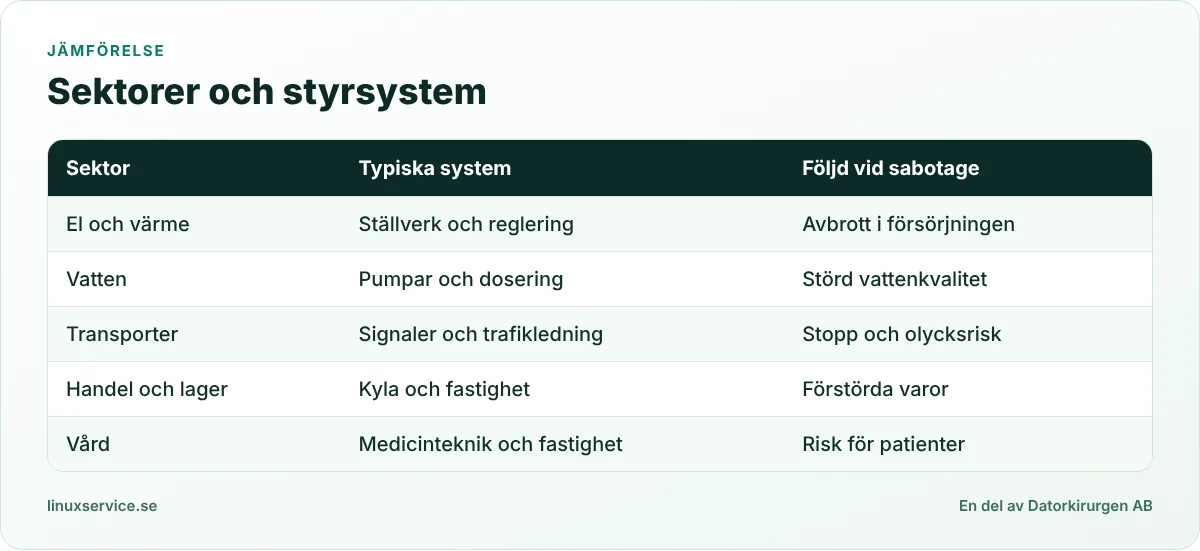
Exposed control systems in Sweden require protection
On the same day as the attack on French shops, SVT published an investigation showing that thousands of systems that control important technology in Sweden have vulnerabilities. In fact, this matches our own experience. For example, a supplier often installs the controllers with remote access for service, but rarely does anyone document that access. Over time, people forget it, while it still remains open. In April 2025, for instance, attackers exploited a weak password in a web-exposed control system at a dam in Bremanger in Norway. The attackers opened a valve fully, and water flowed out for four hours before anyone discovered the intrusion.
In addition, the Swedish Security Service points out the energy and telecom sectors as particularly worthy of protection. The authority has also seen attempts at destructive cyber attacks. This means that protection of control systems is not only an operational matter, but also a matter of society’s preparedness.
Segmentation and controlled remote access
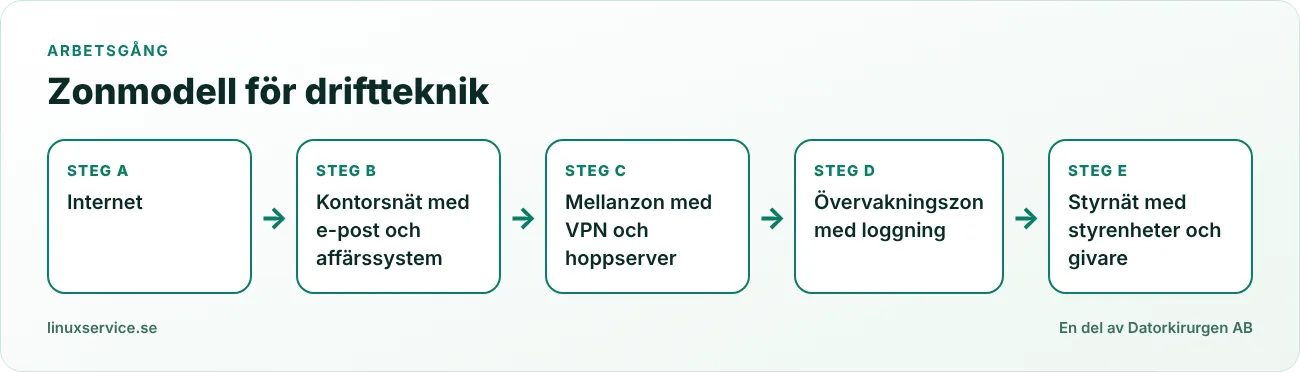
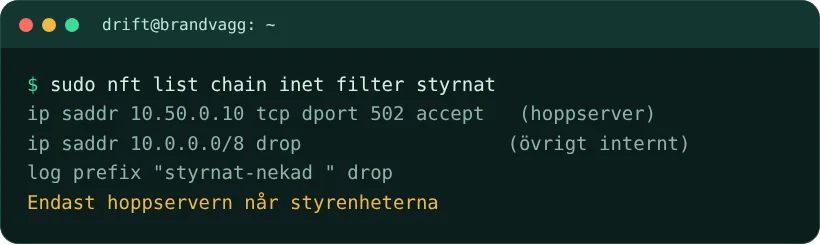
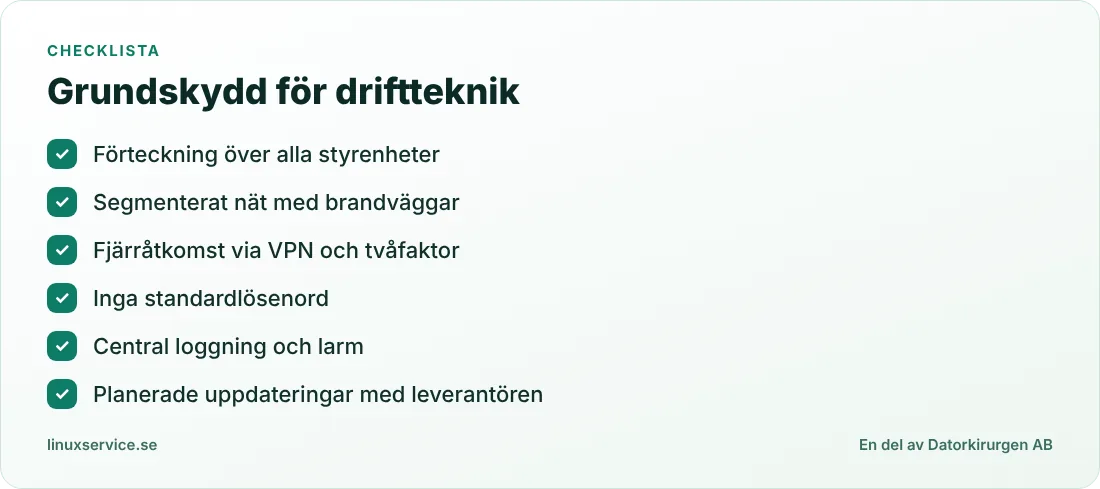
The most important measure is to separate the control systems from the office network and from the internet. We divide the network into zones, where the controllers are furthest in. Traffic between the zones only goes via firewalls with explicit rules. In addition, suppliers reach the systems via a VPN with two-factor sign-in, and the log records every connection. In this way, an attacker cannot go directly from an email in the office to a pump in the waterworks.
Protection of control systems through monitoring and logging
Protection without monitoring does not detect the attack until the damage is done. Therefore, we collect logs from firewalls, jump servers and controllers in a central place. Alerts go out when someone connects outside the agreed time, when someone changes a setpoint or when unknown traffic appears in the control network. In addition, we keep the logs long enough for a forensic investigation.
Protection of control systems at suppliers and in agreements
In fact, many intrusions happen via a supplier. For example, it may be a service company with the same password at all clients, or a remote tool that nobody ever closes. Therefore, we go through which suppliers have access, how they sign in and what the agreements say about security. We also propose requirements that you can set in the next procurement. Read more about our work with Linux for defence, research and heavy industry.
Requirements from the Cybersecurity Act and NIS2
Protection of control systems is now also a matter of compliance. The Swedish Cybersecurity Act, which is based on the EU NIS2 directive, covers energy, transport, drinking water, waste water and certain manufacturers, among others. The organisations must manage risks systematically and report significant incidents. Moreover, management can bear personal responsibility if the work is inadequate. Consequently, the control systems need to be part of the risk analysis, and not just the office network. We help you map what the law covers and document the protection in a way that holds up in an audit.
Experience from similar incidents
In the spring of 2025, a group with links to Russian intelligence tried to carry out a destructive attack on a heating plant in western Sweden. The plant’s safety systems stopped the attack. Similarly, in December 2025 the safety systems stopped an attack on combined heat and power plants and renewable energy systems in Poland. Both cases show that preventive protection works. The freezer attack, however, shows what happens when it is missing. Our experience is that many organisations believe that they are already protected, and only after an attack do they hear from their consultants that the threat was known. In our view, anyone who knows about a threat should also fix it before someone exploits it.
Contact Linux Service
Linux Service is part of Datorkirurgen AB and works with the protection of control systems for industry, buildings and critical infrastructure. Prices start from €1,300 per hour excluding VAT. Compared with an interruption in power, water or transport, this is a very small cost. Therefore, contact us for a review before something has happened.
Frequently asked questions about protection of control systems
Questions about control systems and operational technology
- What is a control system?
- What is the difference between IT and operational technology?
- Which functions in society depend on control systems?
- Why are old control systems vulnerable?
- What is Modbus?
- Can you update control systems like ordinary computers?
- How many control systems in Sweden are vulnerable?
- Which sectors does the Swedish Security Service point out as particularly worthy of protection?
- Can an intrusion in a control system cause accidents?
- Can you help municipal organisations?
Segmentation, access and monitoring
- What is a zone model?
- What is a jump server?
- How should suppliers get remote access?
- Is a VPN enough?
- Why is two-factor sign-in needed?
- Which logs should you keep?
- How long should you keep the logs?
- Which events should trigger alerts?
- Can you monitor the control network around the clock?
- Can you review our firewall rules?
Suppliers, investigation and price
- How do you review the suppliers’ access?
- Which security requirements can we set in procurements?
- Can you investigate an intrusion in a control system?
- Do you work with railways, ports and aviation?
- Do you help with building automation?
- Do you work with waterworks?
- How long does a review take?
- Do you work remotely or on site?
- What does your help cost?
- How quickly can you start?