Ransomware hits healthcare, dental care, law firms and car dealers. This is how Linux Service protects backups and systems and investigates the attack afterwards.
Ransomware hits businesses that cannot stand still
Ransomware is malicious software that encrypts an organisation’s data and demands a ransom to hand over the key. In addition, attackers now steal data before the encryption. They then threaten to publish the information if nobody pays. As a result, the attack becomes both an outage and a data leak at the same time.
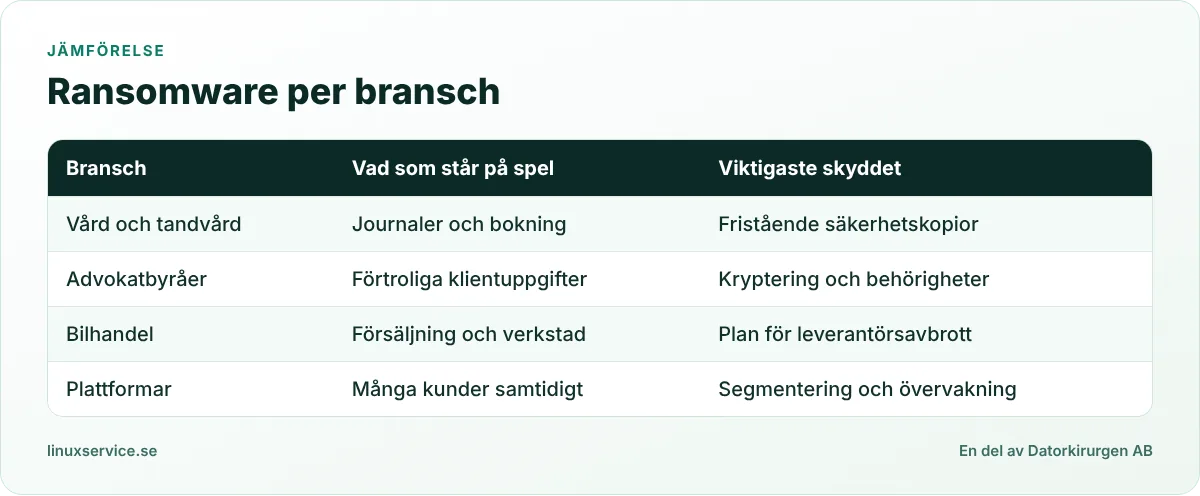
The attackers like to choose businesses that cannot wait. A hospital must be able to read medical records, a dental clinic must be able to book patients and a law firm must reach its files before a hearing. The greater the pressure to return to normal operation, the greater the chance that the victim pays. Therefore, these industries are particularly exposed.
Why healthcare, dental care and law firms are hit
In fact, healthcare and dental care handle sensitive personal data and depend on their record systems. In addition, many clinics are small and lack their own IT department. Law firms, in turn, have confidential information about clients, deals and disputes. A leak there can damage both the clients and the firm’s reputation for a long time. We see the same pattern at accounting firms, estate agents and consultancies.
Car dealers and industry platforms: one supplier, many victims
Many industries depend on shared platforms. Car dealers use business systems for sales, workshops and financing, and dental care often uses the same record system. If the attacker knocks out the platform with ransomware, all customers therefore stop at the same time. For example, in June 2024 an attack hit the supplier CDK Global, whose systems thousands of car dealers in North America depend on. In January 2024, an attack on a data centre at Tietoevry knocked out services for a long list of Swedish customers, including public authorities.
The lesson is that your protection also depends on the supplier’s protection. Therefore, you need to know where your data is, how the supplier takes backups and how long you can manage without the platform.
How a ransomware attack works
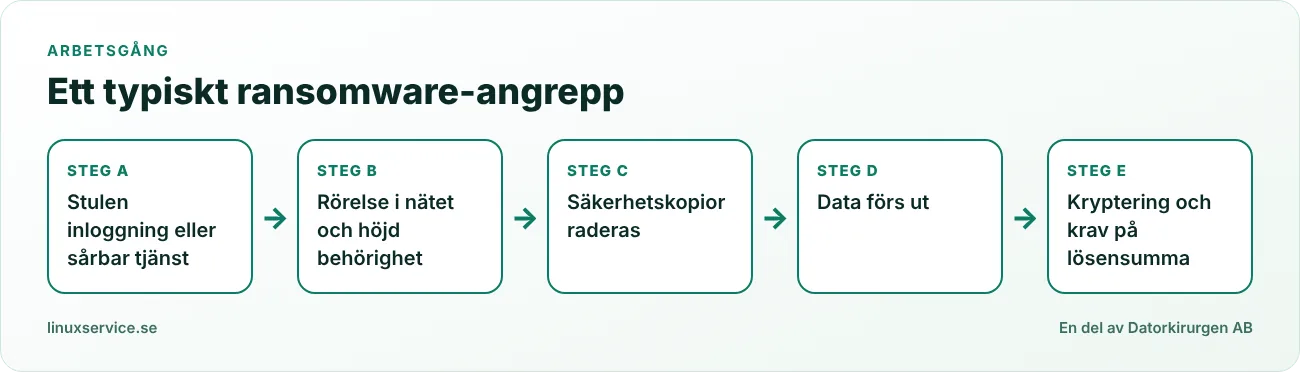
Most attacks start with a stolen sign-in, a phishing email or a vulnerable service that is reachable from the internet. The attacker then moves on in the network, looks for the backups and tries to delete them. Only after that does the encryption start, often at a weekend or at night. In other words, the whole process can go on for days before anyone notices anything, and that gives an opportunity to stop the attack in time.
Backups that the attacker cannot reach
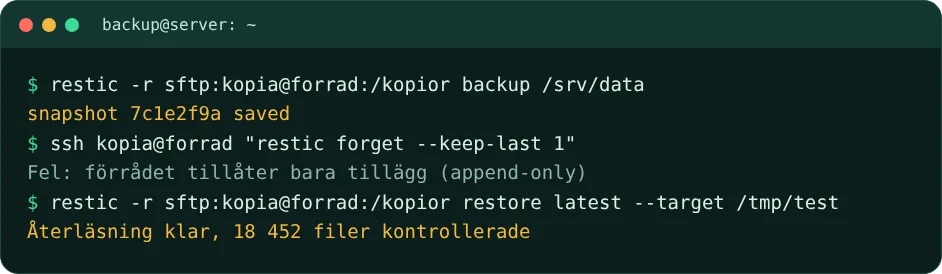
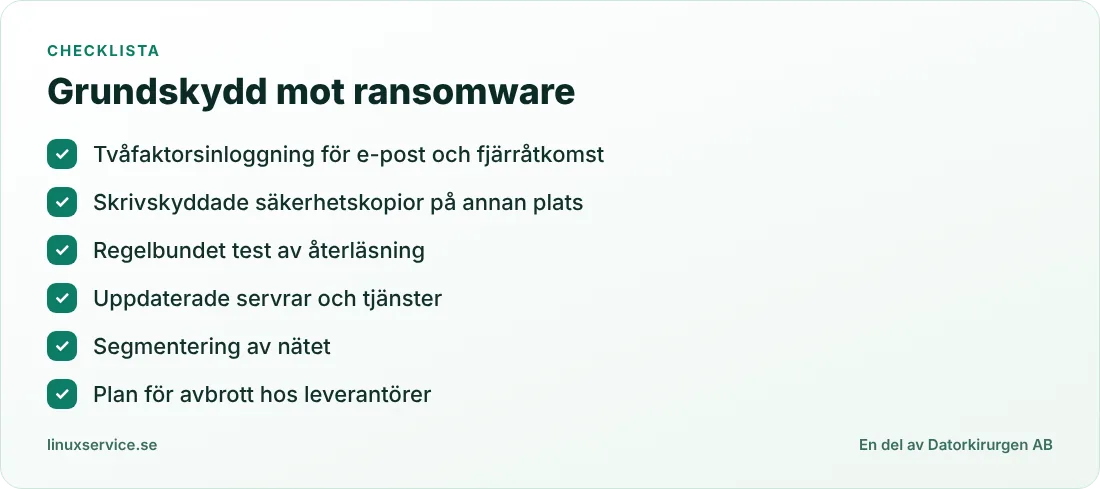
The most important measure against ransomware is backups that the attacker cannot delete. This means copies that are write-protected, in another location and with different sign-in details from daily operation. In addition, you must test the restore regularly. In fact, a backup that nobody has tested is only an assumption. We set up such solutions on Linux servers and in the cloud, and we document how long a full restore takes.
Practising a restore before an attack
In addition, a backup only has value if you can restore it within a reasonable time. Therefore, we carry out restore exercises where we restore a whole server or database to an isolated environment and measure how long it takes. Then we compare the result with how long the business can actually manage without the system. If the time is too long, we change the setup, for example with snapshots that we can restore in minutes. The exercise also reveals whether passwords, keys or documentation are missing. Consequently, you know in advance that the restore works, instead of discovering it in the middle of a crisis.
Experience from similar incidents
When the supplier CDK Global suffered an extortion attack, it knocked out the systems at thousands of car dealers at the same time. Salespeople could neither value nor sell cars, and the workshops stood still. The same risk exists in Sweden for dental care, healthcare and law firms that depend on a shared platform. Our experience is that many organisations assume that the supplier has security under control, and therefore they never ask the question. In addition, after the attack it often turns out that the weaknesses were known. Therefore, in our view you should ask the question, and check the answer, before the attack happens.
Ransomware and the legal requirements
A ransomware attack is usually also a personal data breach. According to the GDPR, you must therefore report the breach to the Swedish Authority for Privacy Protection within 72 hours after you became aware of it. In addition, the Swedish Cybersecurity Act applies to more and more organisations; it is based on the EU NIS2 directive and sets requirements for risk management and incident reporting. Healthcare, digital infrastructure and certain manufacturers belong to the sectors that the law covers. Consequently, management needs to know the requirements before something happens. We help with an incident plan that describes who does what, who reports and how you document the event. In this way, the work stays organised even under strong time pressure.
If ransomware has already hit you
Do not switch off the servers and do not delete anything. Instead, disconnect the affected systems from the network and contact us. We secure the traces according to our protocol for forensic investigation, find out how the attacker got in and check whether data has left the organisation. After that, we restore operation from clean backups and close the attack path. Also read about hardening Linux servers.
Contact Linux Service
Linux Service is part of Datorkirurgen AB and helps healthcare, dental care, law firms, car dealers and other businesses protect themselves against ransomware. Prices start from €1,300 per hour excluding VAT. Compared with an outage for weeks, a ransom and a leak of client data, this is a low cost. Therefore, contact us before the attack happens.
Frequently asked questions about ransomware
Questions about ransomware
- What is ransomware?
- Why do the attackers steal data before the encryption?
- Which industries are hit most often?
- Why are healthcare and dental care exposed?
- Why are law firms exposed?
- How did the attack on CDK Global knock out car dealers?
- What happened in the attack on Tietoevry?
- How does a ransomware attack start?
- How long does an attack take?
- Should you pay the ransom?
Protection and backups
- What is a write-protected backup?
- Why should the copies have different sign-in details?
- How often should we test the restore?
- Are the cloud’s own backups enough?
- How do we protect email?
- What does segmentation mean?
- How do we prepare for an outage at a supplier?
- Can you review our record system supplier?
- Do you set up backups on Linux?
- Can you monitor our servers?
Investigation and price
- What do we do if the attack has already happened?
- Why should you not switch off the servers?
- Can you find out how the attacker got in?
- Can you see whether someone has taken data out?
- Can you restore operation?
- Do you help with the report to IMY?
- Do you work with small clinics and firms?
- Do you work remotely?
- What does your help cost?
- How quickly can you start?