
Insider threats from employees, consultants and suppliers. This is how Linux Service and Datorkirurgen AB prevent and investigate espionage and sabotage from within.
Insider threats are often the hardest threat
Firewalls and antivirus programs protect against attackers from outside. However, an employee, a consultant or a supplier already has access. They sign in with valid details, know the routines and know where the valuable information is. Therefore, technical protection that only looks for malware rarely detects insider threats. The Swedish Security Service devotes a separate section of its situation report to exactly this, under the heading of finding a spy in the organisation.
An insider threat does not have to be intentional from the start. An employee can come under pressure, receive a bribe or be manipulated. It can also concern a person who has left but whose account is still active. Whatever the cause, the result is the same: information leaks or systems suffer damage, and the person who causes it already has access.
Known cases of insider threats
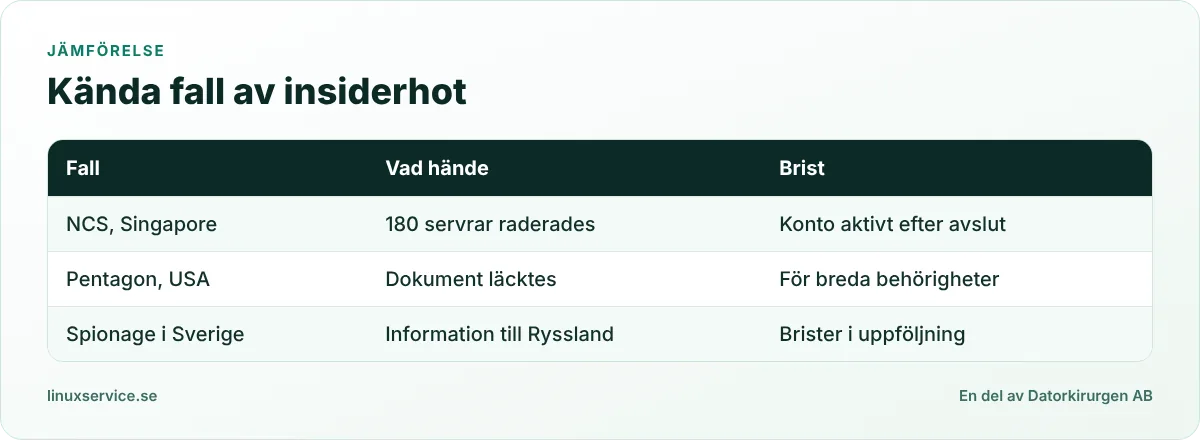
In Singapore, a former IT consultant got into the company NCS and deleted 180 virtual test servers in the cloud. The damage amounted to several million kronor. In the USA, a 22-year-old IT technician leaked classified documents from the Pentagon via a chat service, even though the organisation had invested large sums in firewalls and other security. In addition, Swedish courts have convicted several people of espionage for Russia. Datorkirurgen’s article on cyber security threats from your own employees (in Swedish) describes the cases in more detail.
What the cases have in common is that the technology was in place, but the control of permissions failed. The organisations did not close accounts in time, and nobody detected the unusual activity until the damage was done.
Early warning signs
Before an insider threat, there are often signs that you can detect in time. For example, it may concern an employee who suddenly downloads large amounts of data, signs in at unusual times or seeks information outside their area of responsibility. Dissatisfaction, financial problems or unexpected contacts with foreign representatives can also be signals. At the same time, the organisation must handle such signs with judgement, since most deviations have a harmless explanation. Therefore, we combine technical monitoring with clear routines, so that managers know how to act. In this way, you can intervene before the damage occurs, instead of investigating it afterwards.
Foreign powers recruit insiders
Foreign powers use insiders as a way in. In fact, a person with the right access is worth more than many technical attacks. In addition, the recruitment can go on for a long time and start with harmless contacts. Therefore, organisations with sensitive operations need both security vetting and a clear routine for reporting suspicious contacts. Read more about cyber attacks from foreign powers.
Technical protection against insider threats
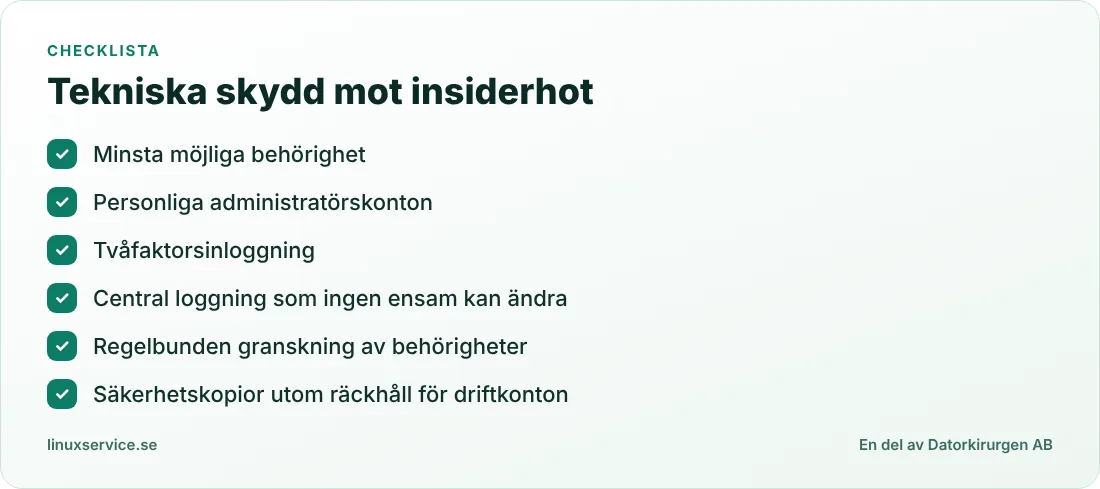
Therefore, the foundation is the principle of least privilege. In other words, each person only gets access to what the work requires, and someone reviews the permissions regularly. Administrator accounts are personal and require two-factor sign-in. In addition, all administration ends up in a central log, so that nobody alone can change or delete the traces. Finally, the backups are out of reach for the accounts that daily operation uses.
When an employee or consultant leaves
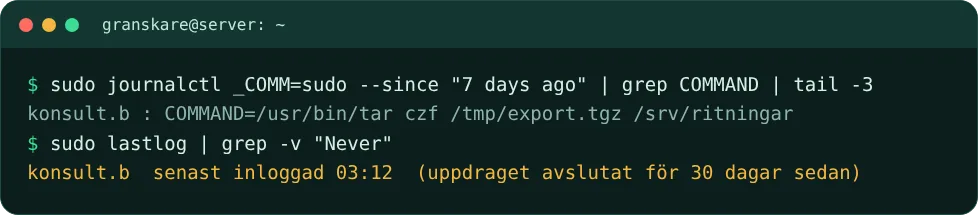
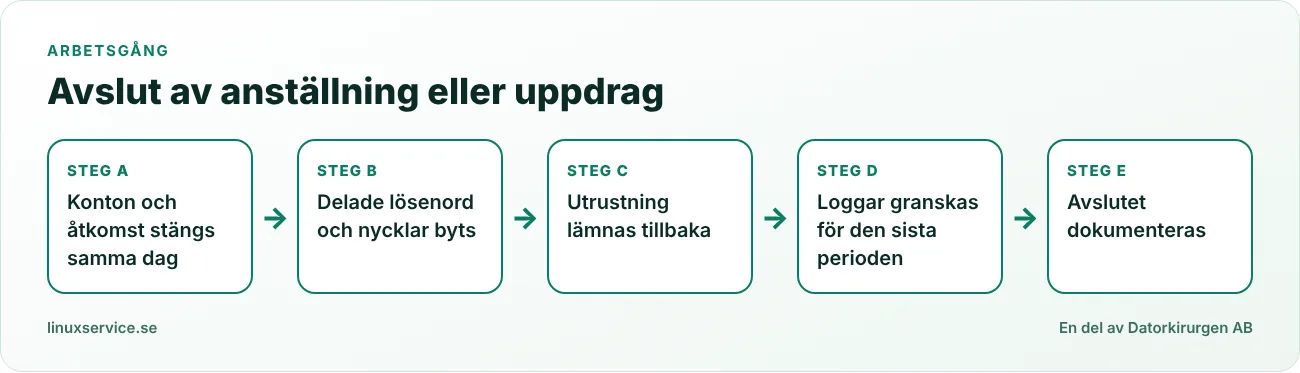
In addition, one of the most common mistakes is that accounts remain after a person has left. This applies especially to consultants, temporary staff and suppliers. Therefore, the routine must be clear: we close all accounts the same day, change shared passwords and remove keys for remote access. After that, we check that no data has left the organisation during the last period.
Permissions that reflect the work tasks
Effective protection against insider threats starts with each account only having the permissions that the task requires. In practice, however, permissions grow over time, since someone adds new rights but rarely removes old ones. Therefore, we regularly go through accounts, groups and administrator roles together with the responsible managers. We document and fix deviations, and as a result it becomes both harder to misuse permissions and easier to detect attempts. In addition, we require that sensitive actions, such as exporting large amounts of data or changing security settings, end up in the log and that someone other than the person who carries them out reviews them.
Overconfidence in your own organisation
Moreover, many underestimate insider threats for the same reasons as other threats: people trust that their own organisation already has control. In the article on cyber security threats from your own employees, Datorkirurgen AB has described how self-confidence and arrogance in management mean that nobody takes the warning signs seriously. One example is the case in Singapore, where a former consultant could delete 180 virtual test servers in the cloud because nobody had removed the consultant’s access. A routine check at the end of the assignment could have fixed the weakness, but nobody had carried it out.
A forensic investigation of a suspected insider threat
Therefore, an investigation of insider threats requires particular care. In fact, the evidence must hold up in an employment or legal review, and at the same time nobody outside the investigation may know about it in advance. We secure logs, copies and timelines according to our protocol for forensic investigation. After that, we report what happened, who had access and which information the attack affected.
Contact Linux Service
Linux Service is part of Datorkirurgen AB and helps organisations prevent and investigate insider threats. Prices start from €1,300 per hour excluding VAT. Compared with a leaked product or deleted systems worth millions, this is a low cost. Contact us in confidence, and we will go through your situation.
Frequently asked questions about insider threats
Questions about insider threats
- What is an insider threat?
- Why are insider threats hard to detect?
- Can an insider threat be unintentional?
- Which roles involve the greatest risk?
- Do foreign powers recruit insiders?
- What happened in the NCS case in Singapore?
- What do we learn from the Pentagon leak?
- Are firewalls enough against insider threats?
- Can consultants and suppliers be an insider threat?
- How common are insider threats?
Protection and routines
- What does least privilege mean?
- How often should we review permissions?
- Why should administrator accounts be personal?
- How do you protect the logs against changes?
- How do you protect the backups?
- What do we do when someone leaves?
- How do you handle shared passwords?
- Do we need security vetting?
- Can you hold training for managers?
- Can you review our routines?
Investigation and price
- How do you investigate a suspected insider threat?
- Can you investigate without anyone noticing?
- Does the evidence hold up in a legal review?
- Can you see whether someone has taken data out?
- Can you recreate deleted systems?
- Do you work with HR and legal?
- Do you work remotely?
- Do you handle the case confidentially?
- What does an investigation cost?
- How quickly can you start?