Less risk and a shorter interruption: this is how we carry out database migration of Oracle, SQL Server, MySQL, MariaDB and PostgreSQL to and between AWS, Azure, Oracle and Google.
Database migration is the most sensitive move of the business
In fact, the database often contains the whole business: customers, orders, finance and history. Therefore, a database migration requires more careful planning than any other part of a move. In addition, errors in data do not always show directly, and they can have major consequences much later. Linux Service has worked with Oracle, SQL Server, MySQL, MariaDB and PostgreSQL for decades, both in own data centres and in the cloud.
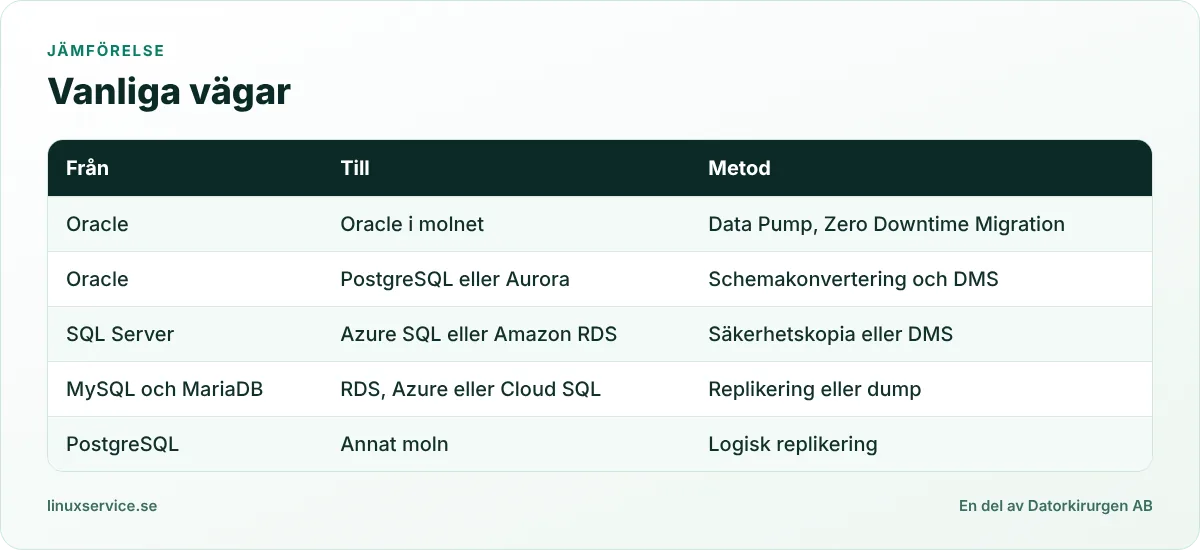
Therefore, we distinguish between two types of migration. In a homogeneous migration, you keep the same database engine, for example Oracle to Oracle or MariaDB to a newer MariaDB. In a heterogeneous migration, on the other hand, you change engine, for example from Oracle to PostgreSQL. The latter requires us to rewrite tables, procedures and functions, and therefore it takes longer.
From Oracle to PostgreSQL and back
Many businesses today want to leave expensive licences and move from Oracle to PostgreSQL. Since 2024, Amazon Web Services (AWS) Database Migration Service has included a schema conversion that uses generative AI for code that the rule engine cannot handle. It converts schemas and code from Oracle, SQL Server and MySQL, among others, to Aurora PostgreSQL and Amazon RDS for PostgreSQL. The tool does a large part of the work, but the result still needs a review by someone who knows both databases.
Sometimes, however, the move goes in the other direction. Businesses that want to keep Oracle can instead move to Oracle Cloud Infrastructure or to Oracle Database@AWS, @Azure and @Google Cloud. There, Oracle runs its database services in the other provider’s data centre. We also help you compare the options before you decide. Also read about Oracle Linux.
A shorter interruption with continuous replication
A long interruption is often what the business worries about most. Therefore, we use continuous replication, where changes in the source database transfer continuously to the target. AWS Database Migration Service, Azure Database Migration Service, Oracle GoldenGate and logical replication in PostgreSQL all work in that way. As a result, the interruption only concerns the cutover itself, which often takes a few minutes.
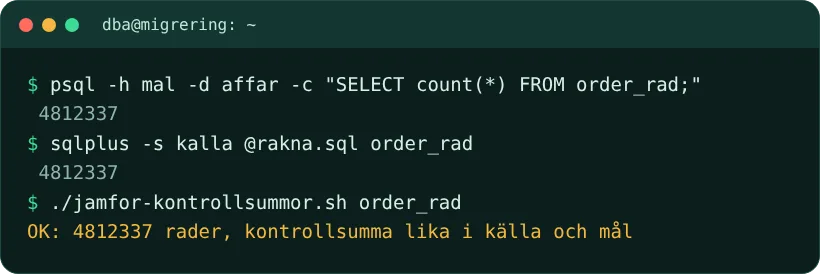
Before the cutover, we compare row counts and checksums in the source and target. We also run the application’s most important flows against the new database. Only when everything matches do we stop writes in the source and point the application to the new database. The old database then remains as a reserve until you have approved the result.
Experience from our own database upgrades
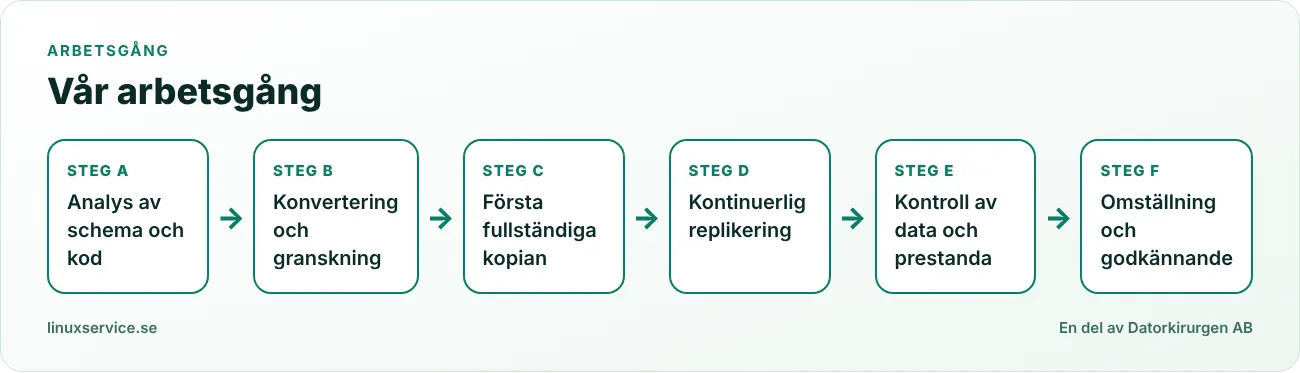
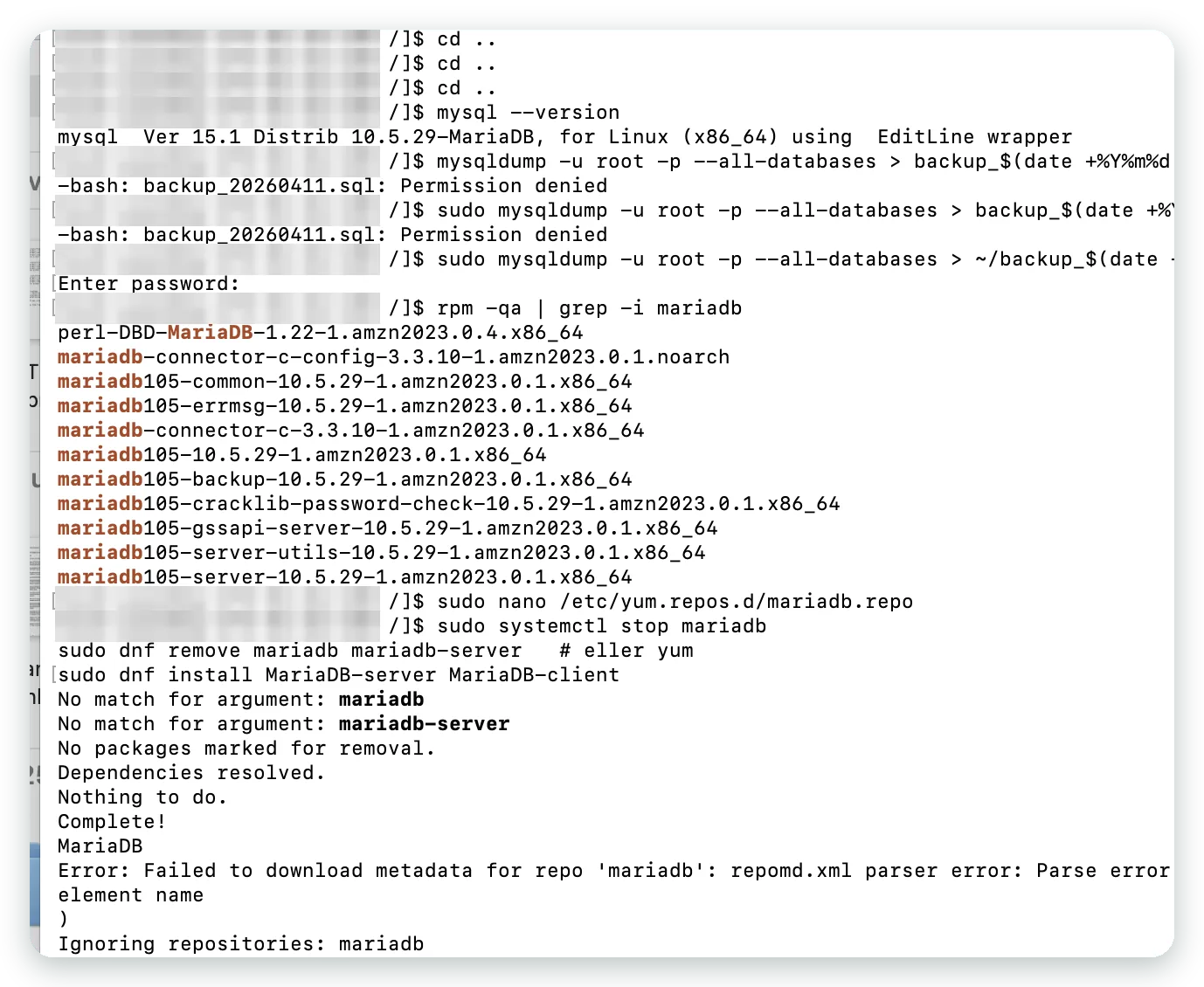
In addition, we do the same work in our own environments. The screenshot below comes from an upgrade of MariaDB on one of our servers in AWS, where we checked the version and packages before we started. Such checks reveal conflicts before they become a problem. Read the whole story in the article on how to upgrade MariaDB on Amazon Linux.
Performance and security after the move
A database migration is also an opportunity to modernise. We review indexes, queries and settings, since a new environment often behaves differently from the old one. In addition, we activate encryption, backups with restore tests and monitoring. The documentation from PostgreSQL is our most important support when moving to PostgreSQL.
Contact Linux Service about database migration
Linux Service is part of Datorkirurgen AB and carries out database migration for businesses across Sweden. We work with all major databases and with AWS, Azure, Oracle Cloud Infrastructure and Google Cloud. Prices start from €1,300 per hour excluding VAT.
Frequently asked questions about database migration
Questions about database migration
- What does a database migration involve?
- What is the difference between homogeneous and heterogeneous migration?
- Can you move from Oracle to PostgreSQL?
- Can you also move from SQL Server to PostgreSQL?
- Can you move Oracle to Oracle Cloud Infrastructure?
- What is Oracle Database@AWS?
- Can you move MySQL and MariaDB to the cloud?
- Does it also work between two different clouds?
- How long does a database migration take?
- How long is the interruption when we switch?
Risk, verification and performance
- How do you know that all data has come along?
- What is continuous replication?
- Do you use AI when you convert code?
- How do you handle stored procedures?
- Can we go back if something goes wrong?
- Does the database become faster in the cloud?
- How do you protect data during the move?
- Do you encrypt the database?
- How do you test the backups?
- Can you also optimise a slow database?
Licences, operation and contact
- Can we save licence costs?
- What does a managed database service cost?
- Do you take care of operation afterwards?
- Do you work with both Linux and Windows?
- Can you upgrade an old database version?
- Do you work remotely?
- Do you come on site in Stockholm?
- How quickly can you start?
- What does your help cost?
- Can you help us choose a database before we decide?