
Red Hat Enterprise Linux for businesses: subscriptions, SELinux, upgrades with Leapp and troubleshooting. We help you in Stockholm and across Sweden.
Why larger organisations choose RHEL
Red Hat Enterprise Linux, often called RHEL, is the standard in many banks, public authorities and industrial companies. Above all, this is due to the long support period, certified software and a clear supplier behind the system. Each major version has ten years of support, and in addition you can buy extended support. Software from SAP and Oracle, among others, is certified for RHEL, which simplifies procurement. Therefore, RHEL is often a requirement in larger contracts.
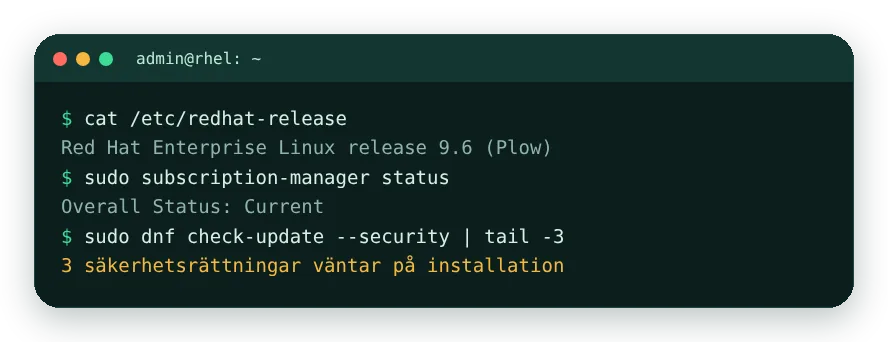
Red Hat released RHEL 10 in May 2025, but many environments still run version 8 or 9. We help keep subscriptions and versions in order. A common problem is servers that have lost their registration and have therefore stopped receiving updates. Nobody notices it until someone checks. Therefore, we go through all servers and make sure that they are registered and updated.
SELinux, firewall and Insights
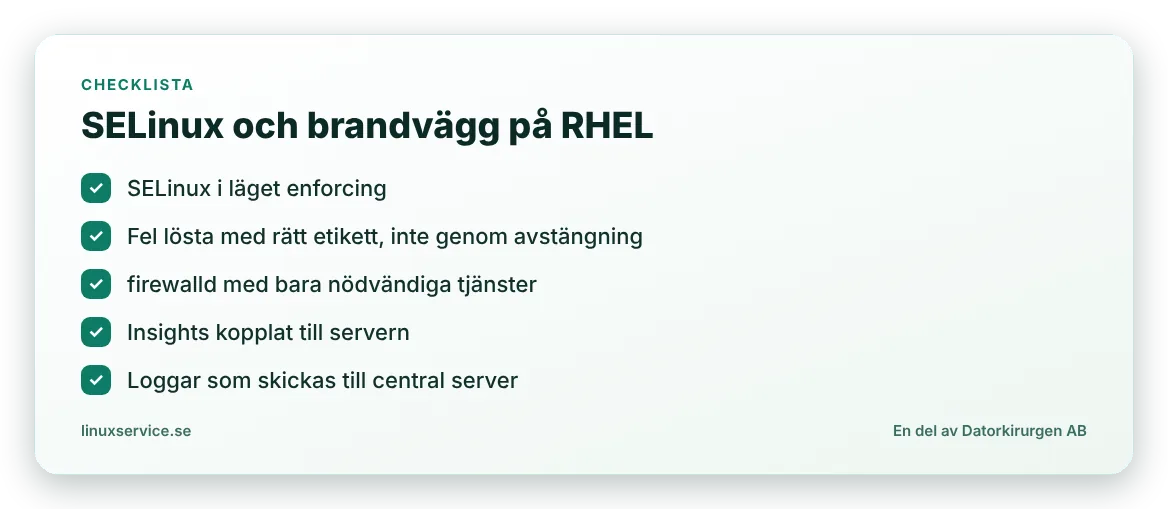
RHEL switches on SELinux by default, and it is an important layer of protection. Unfortunately, many people switch it off as soon as something does not work. That is a mistake, since you can almost always fix the fault with the right label or a boolean setting. We read the log with ausearch and sealert, and after that we fix the real cause. In this way, the server keeps its protection.
We manage the firewall with firewalld, where we only open the services that are needed. In addition, the subscription includes Red Hat Insights. The service compares the servers with known problems and suggests actions. We use it as a complement to our own checks. When Insights flags something, we go through the suggestion before we carry it out, since not all advice suits every environment.
Upgrading to a new major version
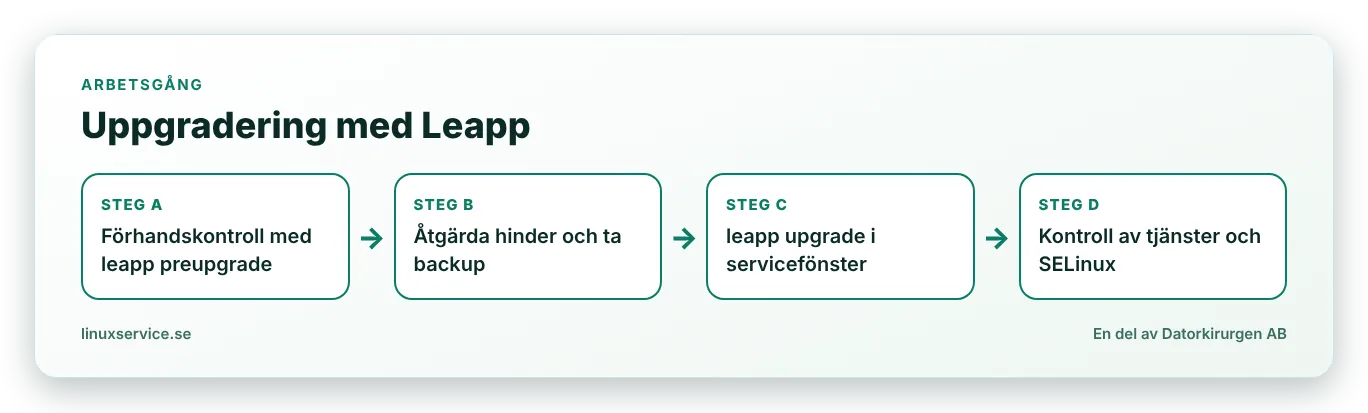
You can go from RHEL 8 to 9 or from 9 to 10 in place with the Leapp tool. First, we run a pre-upgrade check, which shows what prevents the upgrade. Often it concerns old packages, custom kernel modules or settings that no longer exist. We fix each point and take a full backup. If the server runs virtually, we also take a snapshot. After that, we carry out the upgrade in a planned maintenance window.
In some cases, a new installation is better than an in-place upgrade. For example, this applies to servers that have grown organically for many years. In that case, we build a new server in parallel and move the services one at a time. It takes somewhat longer, but the risk becomes smaller. We always recommend the option that suits your operations best.
Troubleshooting when something goes wrong
The most common cases concern services that do not start after an update. We start with systemctl status and journalctl, and after that we check SELinux and permissions. Sometimes it concerns a configuration file that has received a new format. In other cases, a third-party kernel module has stopped working with the new kernel. We find the cause and fix it in the right way.
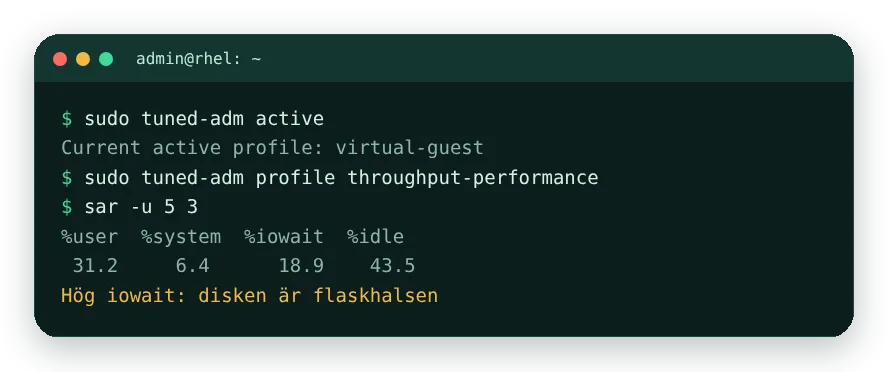
Performance problems are also common. There we use top, sar and iostat to see whether the processor, memory or disk is the limit. In addition, the tuned tool can adjust the server for a database or virtualisation. We always measure before and after a change, so that you see what it actually achieved. Feel free to also read about AlmaLinux, which is binary compatible with RHEL and therefore works in the same way.
Many businesses also run RHEL in AWS, Azure or Google Cloud. There, the hourly price can include the subscription, or you can bring your own licence. We help you choose the right model, since the difference in cost can be large over a few years. At the same time, we make sure that the cloud servers get the same level of security as your own.
Contact Linux Service about Red Hat Enterprise Linux
Linux Service is part of Datorkirurgen AB and has more than 30 years of experience of Linux in business environments. We operate, upgrade and troubleshoot Red Hat Enterprise Linux both in data centres and in the cloud. Official information is available from Red Hat, but we help you put it into practice.
Therefore, contact us when an upgrade approaches or when a server shows operational disruptions. We can also take over the ongoing operation, with updates, monitoring and reports every month. We work remotely or on site in Stockholm. Moreover, you always receive a short summary after each case.
Frequently asked questions about Red Hat Enterprise Linux
Questions about Red Hat Enterprise Linux
- What is the difference between RHEL and free clones?
- How long does a major version have support?
- What is included in a subscription?
- Is there a free developer subscription?
- Why has the server stopped receiving updates?
- How do you register a server with subscription-manager?
- Which software is certified for RHEL?
- Can RHEL run in AWS and Azure?
- What is Red Hat Insights?
- When should we change major version?
Red Hat Enterprise Linux: SELinux and upgrades
- Why should you not switch off SELinux?
- How do you read the SELinux log?
- What is a boolean setting in SELinux?
- How do you open a service in firewalld?
- What does leapp preupgrade do?
- Can you upgrade from version 8 directly to 10?
- What happens to custom kernel modules during an upgrade?
- When is a new installation better than an upgrade?
- How long does an upgrade take?
- How do you go back if something goes wrong?
More about troubleshooting and operation
- Why does the service not start after the update?
- How do you find the bottleneck under high load?
- What does tuned do?
- How often should the server be updated?
- Can you take over the operation of our RHEL servers?
- Do you offer monitoring around the clock?
- Do you work remotely or on site?
- Can you help us with licensing questions?
- What does your help cost?
- How do I contact you about RHEL?