
AlmaLinux is the RHEL-compatible distribution that CERN chose. We install, migrate from CentOS and operate AlmaLinux for businesses across Sweden.
Why CERN chose AlmaLinux
CERN, the organisation behind the Large Hadron Collider particle accelerator, has run Linux on thousands of servers for decades. Previously, the researchers used Scientific Linux and after that CentOS. When CentOS in its old form ended, CERN and Fermilab needed a new foundation. In December 2022, the two laboratories announced that they would move to AlmaLinux. Today, CERN supports both AlmaLinux and Red Hat Enterprise Linux, and AlmaLinux 10 is already in their package archive.
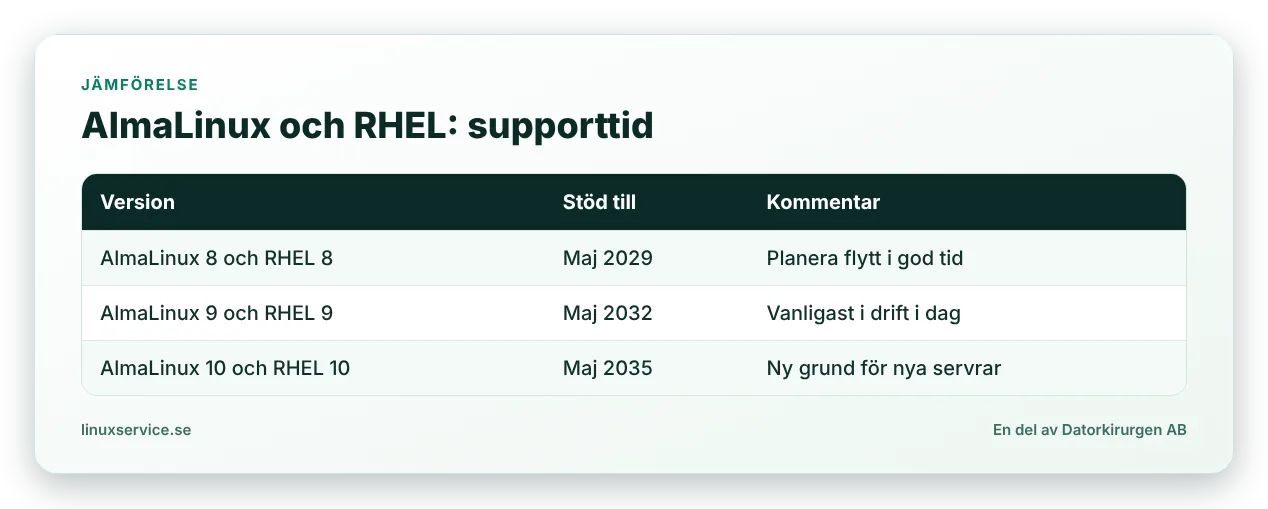
The choice says a lot about the system. AlmaLinux is binary compatible with RHEL, which means that the same programs and packages work on both. At the same time, it is free and a non-profit foundation governs it. For a research centre with enormous amounts of data, stability and a long lifetime are decisive. Therefore, the same qualities make the system interesting for ordinary businesses. According to CERN, AlmaLinux 9 has support until 2032 and AlmaLinux 10 until 2035.
What a business can learn from research environments
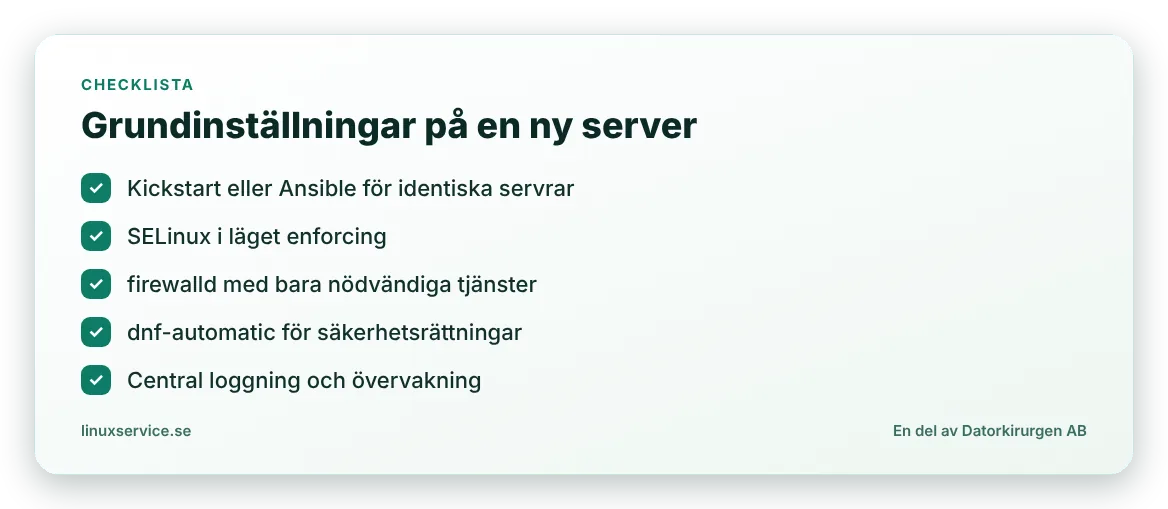
Research environments such as CERN build everything on automation. They install servers from the same template, and code controls the configuration instead of manual changes. In this way, a hundred servers become as predictable to manage as one. The same thinking works for a smaller business. Therefore, we use Kickstart files and Ansible, so that a new server becomes identical to the existing ones.
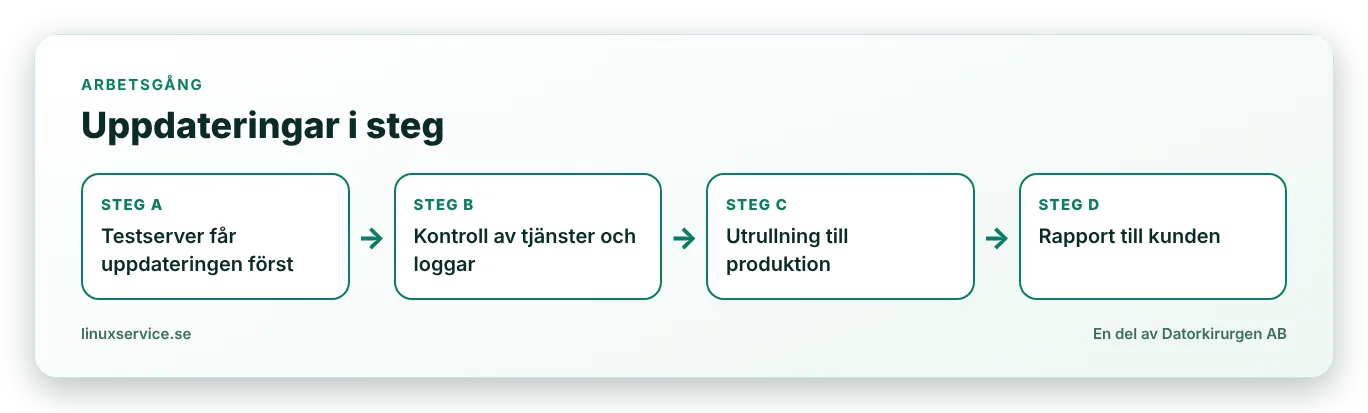
Another lesson concerns updates. Large environments first test on a smaller group of servers, and after that they roll out to the rest. We work in the same way for our clients. A test server receives the update first, and after a few days production follows. If something deviates, we notice it before it affects the business. The routine is standardised and considerably reduces the time needed.
In addition, CERN shares its tools and documentation. Among other things, there are ready-made images for virtual servers and containers. We follow the work, since their solutions can often be used on a smaller scale too. For example, their way of packaging their own programs works just as well for a consultancy with ten servers. In short, even a small business can benefit from the experience of the world’s largest physics laboratory.
Migration from CentOS 7 and CentOS 8
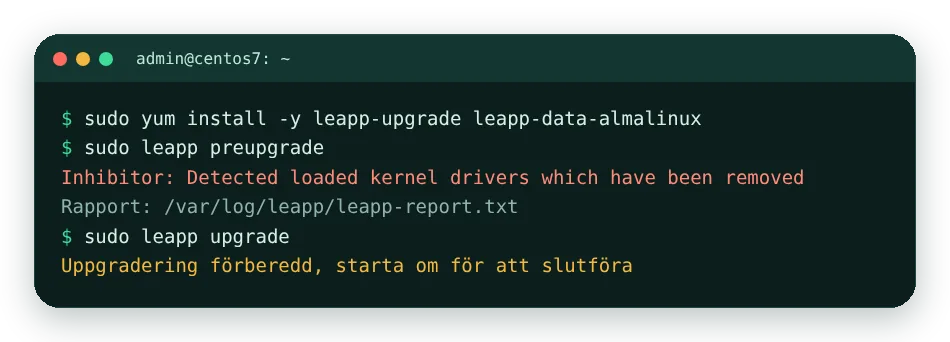
Many businesses still have servers with CentOS 7, even though it stopped receiving updates in the summer of 2024. That is a real security risk. Moreover, the project offers the ELevate tool, which can upgrade a CentOS 7 server to AlmaLinux 8 in place. After that, you can take the next step to version 9. For CentOS 8, there is also a migration script that switches distribution without reinstallation.
We always start with a full backup and an inventory of the programs. Old third-party packages are the most common obstacle, for example control panels or custom kernel modules. In some cases, it is wiser to build a new server and move the services there. We always recommend the path with the least risk. Feel free to also read about Red Hat Enterprise Linux, which has the same foundation.
Operation and security in daily work
In daily work, the distribution works exactly like RHEL. We install packages with dnf, and SELinux is on by default. It stays on, and instead we fix the rules that need adjusting. For the firewall, firewalld does the job. In addition, we set up dnf-automatic, so that the server installs security fixes without anyone having to remember it.
The system suits web servers, databases and computation well. Among other things, we run Apache, PHP-FPM, MariaDB and PostgreSQL on the system. For heavier computation, for example data analysis in Python, it works just as well as at larger research facilities. The difference lies in how many servers you have rather than in how you manage them. With the right routines, such a server lasts for many years. Moreover, we follow up every quarter, so that nothing drifts over time.
Contact Linux Service about AlmaLinux
Linux Service is part of Datorkirurgen AB and has more than 30 years of experience of Linux, from small offices to demanding environments. We install and operate the system, and we migrate old CentOS servers in a controlled way. CERN describes its choice at linux.web.cern.ch, where you also find their support periods.
Therefore, contact us if you have servers that have stopped receiving updates. We carry out an inventory and propose a plan with a clear time estimate. We work remotely or on site in Stockholm. Moreover, we can take over the ongoing operation when the migration is finished.
Frequently asked questions about AlmaLinux
Questions about AlmaLinux
- What is AlmaLinux?
- Why did CERN choose this particular distribution?
- Is the system compatible with RHEL?
- Does it cost anything?
- Who is behind the project?
- How long do versions 9 and 10 have support?
- What is the difference between AlmaLinux and Rocky Linux?
- Can you run it in the cloud?
- Do programs for RHEL also work here?
- Is the distribution suitable for small businesses?
AlmaLinux: migration from CentOS
- Why is CentOS 7 a security risk today?
- What does the ELevate tool do?
- Can you go directly from CentOS 7 to version 9?
- What does an inhibitor in the leapp report mean?
- How do you switch from CentOS 8 without reinstallation?
- When is it better to build a new server?
- How long does a migration take?
- What happens to control panels during a migration?
- Do we need to take a backup first?
- Can you migrate several servers at the same time?
More about operation and support
- How do you install packages?
- Should SELinux be switched on?
- What does dnf-automatic do?
- What are Kickstart and Ansible?
- Can you build identical servers for us?
- Do you run MariaDB and PostgreSQL on the same server?
- Can you take over operation after the migration?
- Do you work remotely or on site?
- What does a migration cost?
- How do I contact you about AlmaLinux?