Debian server for businesses: a stable foundation for web, databases and email. We install, upgrade and troubleshoot Debian in Stockholm and across Sweden.
Why Debian is a safe choice
Debian is one of the oldest Linux distributions and the foundation of Ubuntu and Kali, among others. Volunteer developers run the project, and there is no company that can change the terms. Therefore, many organisations choose a Debian server when they want long-term stability. The stable branch is tested for a long time before release, and as a result there are few surprises. The system suits web servers, databases, email and firewalls.
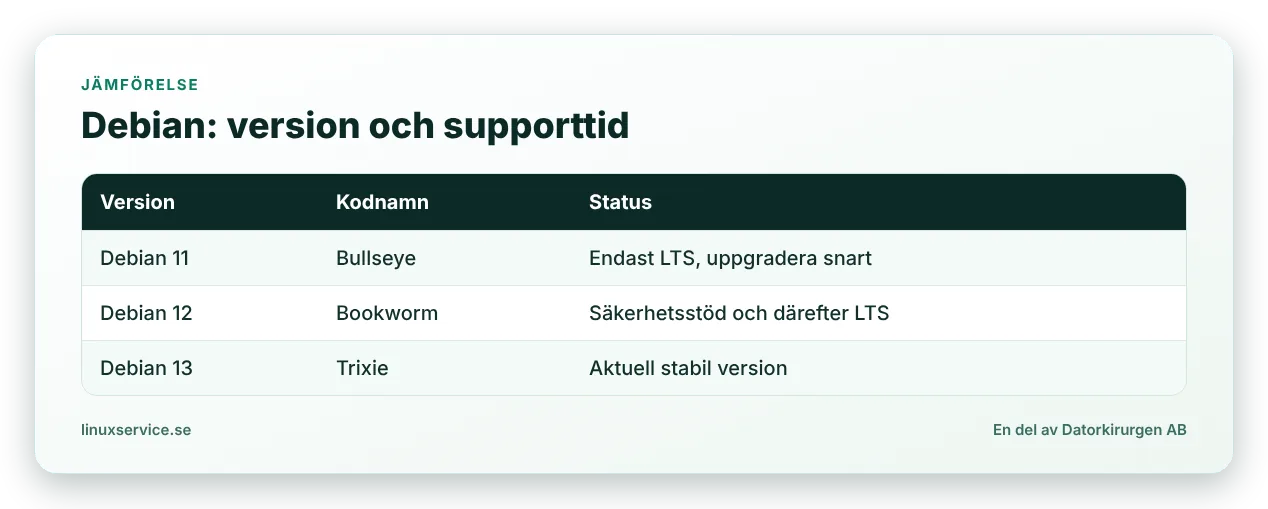
Debian 13, with the code name Trixie, was released in August 2025. Each stable version receives security updates for about three years, and after that the LTS project takes over for another two years. In total, an installation can therefore live for around five years. We keep track of where your servers are in that cycle. When the end approaches, we plan the upgrade in good time.
Installation with only what is needed
We install a new Debian server without a graphical interface. We only choose SSH and the standard tools in the installation, and after that we add the right services. This makes the server faster and less vulnerable. In addition, we set the time zone, time synchronisation and language directly. It sounds obvious, but the wrong time causes problems with certificates and logs.
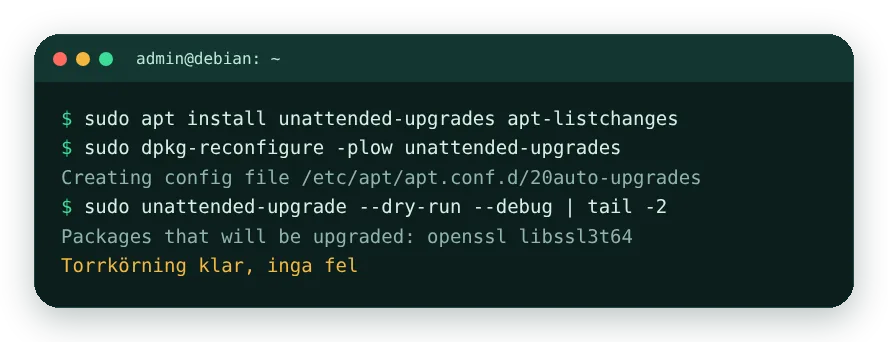
We install security updates automatically with unattended-upgrades. At the same time, we make sure that the server sends an email when something requires a restart. We set up the firewall with nftables, which is the default in newer versions. Sign-in uses SSH keys, and root may not sign in directly. With these basic settings, a Debian server runs stably for many years.
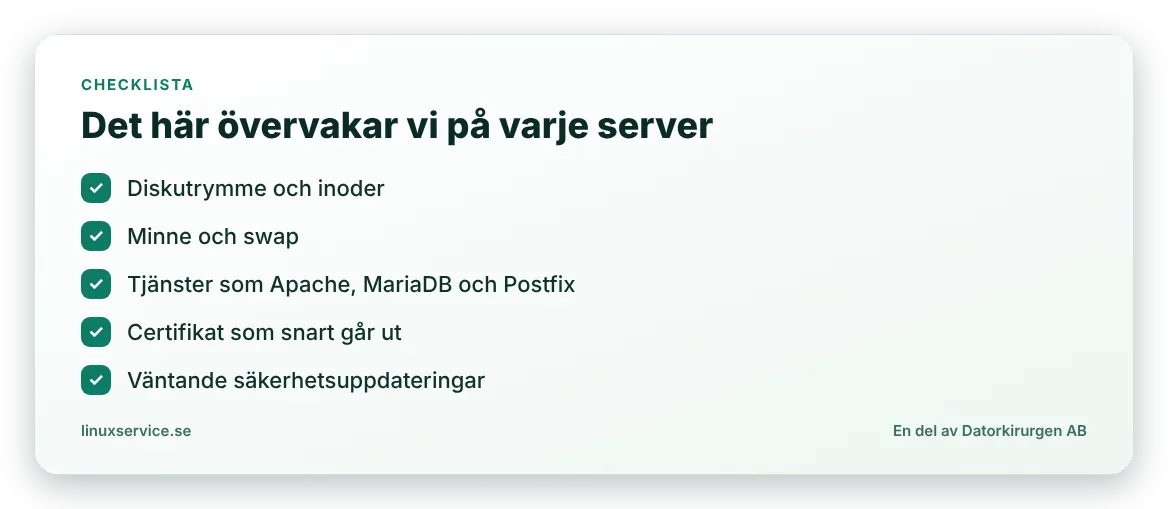
We also add monitoring of disk, memory and services from the start. When something approaches a limit, we receive an alert, and then we can act before the users notice anything. For example, it may be a database that grows or a certificate that will soon expire. In short, operation becomes predictable instead of urgent. We send the alerts to ourselves and, if you wish, also to your own engineer.
Upgrades between stable versions
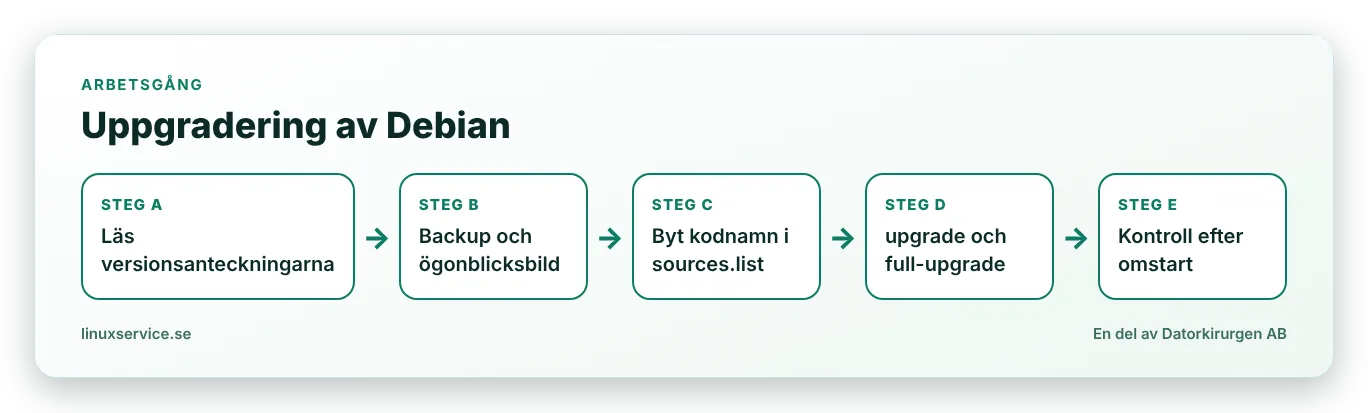
You upgrade Debian by changing the code name in the package sources and then running a full upgrade. The action itself is straightforward, but the groundwork decides the result. First, we read the release notes, since they describe known problems. After that, we remove third-party packages that lack support in the new version. Finally, we take a snapshot or a full backup.
We carry out the upgrade itself in two steps. First, we run apt upgrade --without-new-pkgs, and after that we run apt full-upgrade. Meanwhile, we answer questions about configuration files with care. When the server has restarted, we check services, logs and websites. Feel free to also read about Ubuntu Server, which has a similar process.
For larger environments, we always test the upgrade on a copy first. We clone the server, upgrade the copy and run the same tests as in production. When everything works, we repeat the steps on the real server. It takes a little longer, but you avoid surprises in the middle of the working day.
Common faults and how we solve them
A common fault is that package sources from old versions remain. This causes conflicts that stop the upgrade. Therefore, we clean up the sources before we start. Another fault concerns services that have changed name or default settings between versions. For example, PHP gets a new version, and then Apache or Nginx needs to point to the right module. We check such dependencies carefully.
Disk space is yet another common problem. Old kernels, logs and cache can fill the disk on a small virtual server. We clean up with apt autoremove and also set limits for the logs. If something goes wrong anyway, we always have a way back. That is the foundation of everything we do, whether the assignment is large or small. After each action, we also write a short note in your operations log, so that the next engineer understands what happened.
Contact Linux Service about Debian server
Linux Service is part of Datorkirurgen AB and has worked with Linux for more than 30 years. We install, upgrade and operate Debian for businesses, associations and schools across Sweden. Official documentation is available on the Debian website, but we are happy to take care of the practical side.
Therefore, contact us when a version approaches its end or when a server shows operational disruptions. We carry out a quick review and give a proposal with a schedule. We work remotely or on site in Stockholm. Moreover, you always know what has been done and why.
Frequently asked questions about Debian server
Questions about Debian server
- What is the difference between Debian and Ubuntu?
- How long does a stable version receive updates?
- What is Debian LTS?
- Which version is current right now?
- Is Debian suitable for a web server?
- Do you have to pay for Debian?
- What do the code names mean?
- Can Debian run in the cloud?
- Is Debian good for databases?
- How do I see which version the server runs?
Debian server: installation and upgrades
- Should the server have a graphical interface?
- How do you activate automatic security updates?
- What is nftables?
- How do you switch off sign-in as root?
- How do you upgrade to the next stable version?
- Why should you read the release notes first?
- What does apt full-upgrade do?
- How do you handle questions about configuration files?
- Can you skip a version?
- How do you go back if the upgrade fails?
More about troubleshooting and support
- Why do old package sources stop the upgrade?
- How do you remove old kernels?
- Why does PHP not work after the upgrade?
- How do you limit the size of the logs?
- Can you take over the operation of our Debian servers?
- Do you also help schools and associations?
- Do you work remotely or on site?
- How quickly can you help with urgent faults?
- What does an upgrade cost with you?
- How do I contact you about Debian?